
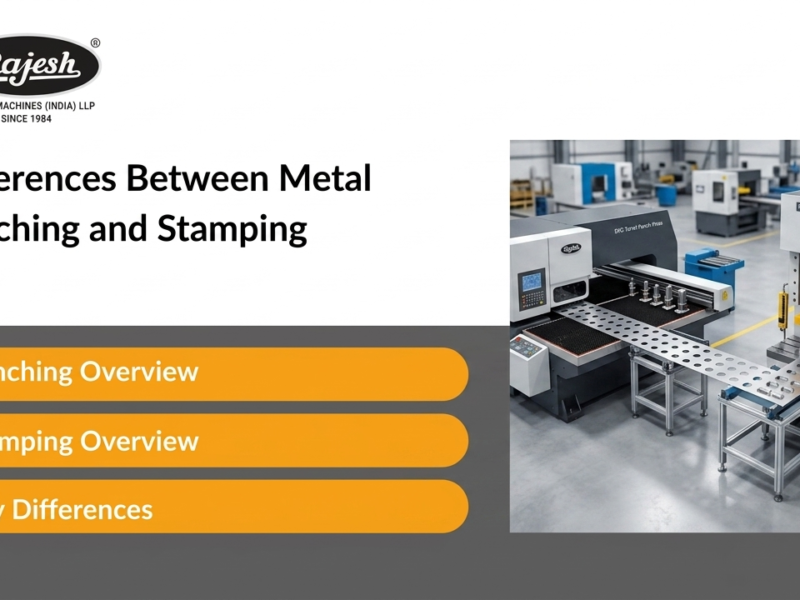
Differences Between Metal Punching and Stamping
Introduction
Most people in sheet metal fabrication use “punching” and “stamping” like they mean the same thing. Suppliers do it. Buyers do it. Even some machine manufacturers do it in their own brochures.
They are not the same thing.
That does not make those people wrong — the two processes are closely related and do share equipment. But when you are specifying a machine, quoting a job, or setting up a production line, the difference matters. Buy the wrong setup and you either overpay for capability you never use, or you hit a wall when the process cannot produce what your customer actually needs.
What Is Metal Punching?
Take a sheet of metal. Push a hardened tool through it. A small piece of metal falls out the bottom — that piece is called a slug — and what stays behind is a hole.
That is punching. The tool is the punch. Below the sheet sits a matching die that supports the material and lets the slug drop through cleanly.
No heat. No burning. No cutting gas. The punch shears through the metal mechanically, which is why punched edges are clean and consistent — and why a well-maintained punch and die set can run hundreds of thousands of cycles before you need to think about replacement.
The hole shape comes entirely from the punch shape. Round punch makes a round hole. Rectangular punch makes a slot. Simple logic, but worth saying because it means your tooling investment is tied directly to how many different hole shapes your work requires.
Where you see punched parts in everyday products:
- The cable entry holes in electrical enclosures and switchgear panels
- Ventilation slots in HVAC grilles and diffuser panels
- Bolt hole patterns in structural steel brackets and flat bar
- Perforated sheets in machine guards, acoustic panels, and filters
- Mounting holes in auto components, chassis brackets, and body reinforcements
The machine running all of this is a power press. Different types of power press machines are used depending on material thickness, production volume, and tooling requirements.
For workshops punching many different hole sizes and patterns across varied jobs without wanting to change tooling manually every time, CNC turret punching machines handle that flexibility automatically.
What Is Metal Stamping?
Here is where people get tripped up.
Stamping is not a single operation — it is a category. It covers everything a press and die can do to flat sheet metal. Punching is one thing under that category. But so is blanking, forming, drawing, embossing, and coining.
A stamped part is not just a sheet with holes in it. It is a finished or near-finished component that has been cut to shape, formed into a profile, and often drawn into three dimensions — all using a press.
Think about the inner drum of a washing machine. It starts as flat sheet steel. By the time it comes off a stamping line, it is a cylindrical shell with hundreds of holes in it, formed flanges, and a finished shape ready for assembly. That entire transformation — the blanking of the flat disc, the drawing into a cylinder, the punching of the holes — is stamping.
Progressive stamping takes this further. The sheet feeds through a die with multiple stations. Each station does one thing — punches a hole, adds a bend, trims an edge. By the time the strip exits the last station, a complete part drops off. One press stroke at a time. No operator handling between operations.
This is how automotive manufacturers produce seat brackets and door reinforcements at millions of pieces annually. Not by running separate operations on separate machines, but by engineering a single die that handles the full sequence.
High-volume production environments often rely on mechanical or hydraulic press systems depending on forming complexity and tonnage requirements.
Common operations that fall under metal stamping:
Operation | What It Does |
Blanking | Cuts the outer profile of a part from the sheet |
Punching | Removes material to create holes and slots |
Bending / Forming | Creates angles, flanges, channels |
Drawing | Pulls flat sheet into a 3D cup or shell |
Embossing | Raises or recesses surface detail without cutting through |
Coining | High-pressure compression for very tight dimensional accuracy |
The Actual Difference — And Why Blanking Confuses Everyone
Punching makes holes. Stamping makes parts. That is the short version.
But the question that always comes up is blanking — and it deserves a direct answer because it sits right in the middle.
Blanking and punching are physically identical operations. Same machine. Same motion. A punch goes down, material gets separated. The difference is which piece you care about.
In punching — you care about the hole. The slug that falls out is scrap.
In blanking — you care about the piece that falls out. The sheet with the hole in it is now the scrap.
Same action. Opposite focus. Both are stamping operations.
Punching vs Stamping: Side-by-Side
Metal Punching | Metal Stamping | |
What it is | One specific operation — hole making | A broad process covering multiple sheet metal operations |
Input | Flat sheet | Flat sheet or coil |
Output | Sheet with holes; slug is scrap | Finished or semi-finished component |
Tooling | Punch and die matched to hole shape | Single-stage or progressive dies |
Complexity | Low | Low to very high depending on part |
Machine | Power press | Power press — same equipment, often higher tonnage |
Best volume | High-volume repetitive hole making | High-volume with progressive tooling; lower volume with single-stage |
Heat involved | No | No (except specialised hot stamping) |
Advantages of Punching — The Honest List
Speed is the obvious one. A mechanical power press punches at 60 to 100 strokes per minute on standard work. For hole making at volume, nothing mechanical beats it.
But the advantage people underestimate is cost per hole. Once the tooling is set up, punching is cheap to run. No assist gas. No consumable cutting heads. No laser source with a limited lifespan. Electricity and occasional punch maintenance — that is your running cost.
Edge quality is another one that matters downstream. A well-set punch and die leaves a clean edge with minimal burr. Most punched parts go straight to the next operation without any finishing. Compare that to plasma cutting, where you are often deburring or grinding edges before you can use the part.
No kerf loss either. Punching removes exactly the slug — nothing around it burns away. On tight nesting layouts, that material saving adds up.
The limitation is equally obvious: punching only makes holes. It cannot form a flange, draw a shell, or cut a complex outer profile. The moment your job requires more than holes in flat sheet, you are into stamping territory.
Advantages of Stamping
The main advantage of stamping is that a well-designed stamping operation eliminates handling.
In a fabrication workflow where punching, shearing, forming, and assembly are all separate steps with parts moving between machines and operators, there is time and labour cost at every transfer. A progressive stamping die collapses that entire sequence into one press, running automatically. The part that comes off the last station is ready for assembly. Nothing moves. Nothing waits.
At high volumes, the per-part economics of progressive stamping are difficult to argue with. The tooling investment is real — a complex progressive die is expensive. But spread across 100,000 parts, that cost becomes small. And the consistency is machine-controlled, not operator-controlled. Every part is identical.
The other thing stamping handles that punching cannot is three-dimensional geometry. Drawn shells, formed channels, ribbed panels, embossed surfaces — any shape that requires the sheet to be pushed into a profile rather than just cut. That is stamping territory.
Where stamping loses out is at low volumes. If you need 200 custom brackets with a blanked profile and four holes, building a stamping die for that job makes no economic sense. Run it as two separate operations on a power press with simple tooling. Faster setup, lower total cost, done.
Which Industries Use Which — And How
Automotive is the clearest example of stamping at scale. Door panels, roof skins, floor reinforcements, seat frames — almost every pressed metal component in a car is stamped progressively. Bracket holes and wiring harness channels are punched. But the parts themselves are stamped.
Electrical and switchgear manufacturing leans heavily on punching for enclosures, gland plates, and busbar mounting patterns. Terminals and connector housings — the small precision components inside switchgear — are stamped at high speed on dedicated presses.
HVAC is mostly punching. Grilles, diffuser panels, perforated sheets — all punched. Formed duct sections and flanged air handling components are stamped, but the volume of punching work in an HVAC fabrication shop is significant. Most of these workshops run punching alongside shearing and press brake bending as a standard three-machine workflow.
Appliances split clearly: external panel holes are punched, internal structural components like washing machine drums and refrigerator liners are drawn and stamped.
General fabrication — this is where punching does the majority of its daily work in the real world. Holes in brackets, slots in flat bar, knockouts in enclosures. Not glamorous work, but it is the bread and butter of most sheet metal workshops. Stamping shows up as single-stage blanking when a job requires a custom profile cut from sheet.
Cost Reality: What the Numbers Actually Look Like
Tooling is where the cost difference lives.
A standard punch and die set for common hole sizes costs a few thousand rupees. Simple, replaceable, widely available. If a punch wears out or breaks, you replace it the same day.
A single-stage stamping die for a moderately complex profile — somewhere between ₹30,000 and ₹2 lakh depending on the geometry. A progressive die for an automotive component or high-complexity part — ₹2 lakh on the low end, potentially much higher for multi-station precision work.
That tooling investment is only rational if you have the volume to recover it. At 500 parts, a ₹1.5 lakh die is a significant per-part cost. At 50,000 parts, it barely registers.
The machine itself is not where the cost difference lives. Both processes run on power presses. A 50-ton mechanical press handles punching and single-stage stamping. Higher tonnage becomes relevant for progressive stamping with large dies or deep drawing operations that need sustained force through the full stroke — that is where hydraulic presses earn their place.
Running costs are similar for both. Electricity, tooling wear, periodic maintenance. Progressive stamping adds lubrication system costs and more complex die maintenance, but nothing dramatic.
The practical guide:
Low volume, varied jobs → punching with simple tooling, fast changeover
High volume, consistent parts with multiple features → stamping, invest in the tooling
Not sure → run it as punching first and revisit when volume justifies the die investment
Choosing the Right Machine
This question comes up more than the punching vs stamping question, honestly. And the answer is less about which process and more about what your material and volume actually require.
Mechanical power press — the default choice for punching and blanking at volume. Fast strokes, low running cost, simple to operate. Works well on mild steel, stainless, aluminium, copper up to medium thickness. If speed and cost efficiency matter more than force control, start here.
Hydraulic power press — slower, but the ram delivers full tonnage throughout the stroke, not just at the bottom. That matters for deep drawing and thick material forming where you need consistent pressure all the way through the operation, not a fast impact. Also better for jobs where stroke length and force need to be adjustable.
Pneumatic power press — compressed air drive gives a smoother, more controllable stroke than a flywheel. The preferred choice for thin or delicate materials — gaskets, precision electrical components, rubber parts — where a mechanical hit would damage the part or distort the material.
Most workshops doing a mix of punching and single-stage stamping run a mechanical press. When the work gets into forming or drawing territory, hydraulic becomes the right answer.
Conclusion
Punching makes holes. Stamping makes parts. That covers ninety percent of the practical difference.
The longer version: punching is one specific operation inside the broader category of stamping. When a job requires nothing more than holes in flat sheet, punching on a power press with simple tooling is the fastest and cheapest way to do it. When a job requires a shaped, formed, multi-feature component — blanked, formed, and possibly drawn — that is stamping, and the setup and tooling investment reflect that.
Most fabrication floors do both. A power press running a punch and die in the morning and a blanking die in the afternoon is not unusual. The machine is the same. What changes is the tooling and what you are trying to produce.
Getting the press type and tonnage right for your specific work is what makes the difference between a machine that earns back its cost quickly and one that fights you every day.
Talk to Rajesh Power Press — UAE
If you are figuring out whether your production needs a punching setup, a stamping configuration, or both — we can give you a straight answer based on your actual material, operation, and volume. Not a catalogue recommendation. A real one.
Rajesh Power Press manufactures mechanical, hydraulic, and pneumatic power presses and works with fabricators across the UAE to match the right machine to the right job.
Contact us at rajeshpowerpress.ae — tell us what you are making and we will tell you what you need.