
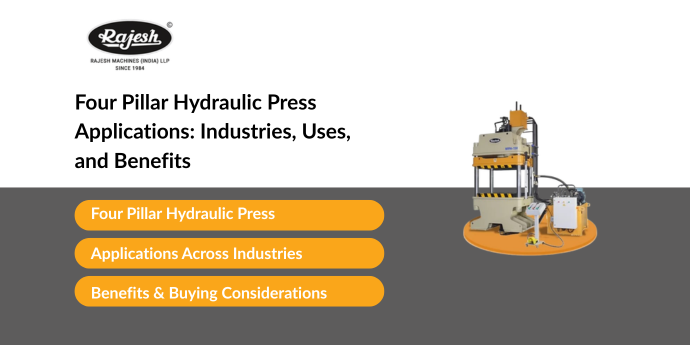
Four Pillar Hydraulic Press Applications: Industries, Uses, and Benefits
Introduction
Walk into almost any metal forming workshop and there’s a good chance you’ll find a four pillar hydraulic press at the center of operations. These machines are used for everything from pressing and punching to deep drawing and shaping sheet metal, making them one of the most practical and versatile pieces of equipment in fabrication.
Their biggest strength is simple: they are not designed for just one task, but for a wide range of jobs across different industries. In this post, we’ll look at where four pillar hydraulic presses are commonly used, why they are such a reliable choice for these applications, and the key benefits that make them a long-term asset on the shop floor.
What Makes a Four Pillar Hydraulic Press Different
A four pillar hydraulic press, also called a four column press, uses four vertical columns to guide the ram as it moves down onto the workpiece. Those four columns do more than just look sturdy — they distribute pressing force evenly across the entire bed, which keeps the platen perfectly aligned even when force is applied off-center. That even distribution is the whole reason this configuration exists: it gives you the stability of a fully enclosed frame along with the flexibility to work with dies of different sizes and shapes without the frame flexing or losing accuracy.
The machine typically runs on a mainframe fabricated from stress-relieved rolled steel plate, with a hydraulic cylinder system that’s driven by an electric motor and pump generating consistent pressure throughout the stroke. Because hydraulic force is applied through fluid pressure rather than mechanical linkage, the operator gets precise control over speed, stroke length, and pressing force, which is exactly what a lot of the applications below actually require.
Industries That Rely on Four Pillar Hydraulic Presses
Automotive Component Manufacturing
Automotive fabrication uses four pillar hydraulic presses for forming, blanking, and drawing components where consistent force across the full working area really matters. Panels, brackets, and structural parts that need to hold tight dimensional tolerances benefit from the even pressure distribution the four-column design provides, especially on parts where the die isn’t centered directly under the ram.
Deep Drawing Applications
Deep drawing is where the four pillar design genuinely shines. Because the ram stays precisely aligned through the entire stroke, the press can form flat sheet metal into hollow, three-dimensional shapes without wrinkling or tearing the material. This makes it well suited to producing components like kitchen sinks, cookware, fuel tanks, and enclosures, where the depth of the part is greater than its diameter and even wall thickness matters.
Bearing Installation and Extraction
In workshops handling machinery maintenance and assembly, four pillar hydraulic presses are commonly used for installing ball bearings and extracting bushings. The controlled, steady force a hydraulic system delivers is far gentler on precision components than impact-based methods, which reduces the risk of damaging bearing races or housings during installation.
Food Processing Equipment Manufacturing
It might not be the first industry that comes to mind, but four pillar hydraulic presses are used in the production of khakhra-making machines and similar food processing equipment, where consistent, repeatable pressing action is essential to the equipment’s own function.
Multi-Drilling and General Fabrication
Multi-drilling machines and general metal fabrication setups use four pillar presses for punching, piercing, and forming operations where the die needs firm, even support. The open access to the bed from front and rear also makes it practical for shops handling varied job work rather than a single repetitive product line.
Appliance and Sheet Metal Component Production
Appliance manufacturing draws on four pillar presses for stamping and forming sheet metal housings, panels, and brackets. Since appliance production often runs across a range of part sizes and shapes, the flexibility to swap dies without needing a different machine for each geometry is a real practical advantage.
Core Operations a Four Pillar Press Handles
Across these industries, the same handful of operations show up again and again:
- Drawing and deep drawing — forming flat sheet into hollow, three-dimensional shapes
- Blanking — cutting flat shapes out of sheet stock as a first step before forming
- Punching and piercing — creating holes or cutouts in a workpiece
- Coining — precision forming for fine detail or embossing
- Stamping — general sheet metal shaping using dies
- Sizing and straightening — correcting dimensions on formed or cast parts
Why Four Pillar Hydraulic Presses Are the Practical Choice
Even Force Distribution
The four-column construction means pressing force is spread evenly across the bed, so the platen stays aligned even when the die isn’t perfectly centered. This is one of the biggest practical differences compared to a single or twin-column press, where off-center loading can cause the ram to tilt slightly under pressure.
Precise, Controllable Force
Because hydraulic systems apply pressure through fluid rather than a mechanical crank, operators can fine-tune pressing force, stroke speed, and dwell time to match the material and part being formed. That level of control matters when you’re working with materials that are sensitive to how quickly force is applied, like thinner gauge sheet prone to cracking under sudden pressure.
Flexibility Across Multiple Applications
A single four pillar press can move between drawing, blanking, punching, and coining jobs simply by changing the die, which is a real advantage for job shops that don’t run one dedicated product line. Instead of investing in several specialized machines, a well-specified four pillar press can cover a broad range of the work coming through the shop.
Durability and Consistent Output
A properly built four pillar press, with a frame that’s stress-relieved and free of welds at load-bearing points, holds its accuracy over years of continuous use. Combined with hardened, chrome-plated piston rods and forged cylinder bodies, the machine is built to produce consistent, repeatable results shift after shift without the frame gradually losing alignment.
Safety and Overload Protection
Standard features like pressure relief valves protect both the machine and the operator from overload conditions, while a properly labeled and ferruled electrical control panel makes fault diagnosis fast and safe rather than a guessing game during downtime.
Choosing the Right Tonnage for Your Application
Four pillar hydraulic presses come in a wide tonnage range, and matching capacity to your actual work is the single biggest decision in the buying process. Lower tonnage models, generally in the 10 to 50 ton range, suit lighter forming, bearing installation, and general fabrication work. Mid-range models, roughly 80 to 150 tons, handle heavier stamping, blanking, and moderate deep drawing applications. Higher tonnage models, from 200 tons upward, are built for heavier deep drawing, sizing, and forming operations on thicker gauge material.
Along with tonnage, pay attention to stroke length, slide and table size, and daylight (the maximum open height between the slide and table), since these determine what size and shape of die and workpiece the machine can actually accommodate. A press with plenty of tonnage but limited daylight can still turn out to be the wrong machine for a taller die set.
Optional Features Worth Considering
Depending on your production needs, a few optional additions can make a real difference to day-to-day operation:
- PLC system with HMI for programmable stroke control and easier operator handling across different jobs
- Quick die change systems to reduce changeover time between production runs
- Die cushion for deep drawing applications that need controlled counter-pressure during the draw
- Die loader for shops running heavier dies that are impractical to change manually
- Pressure strip for applications requiring even, distributed clamping pressure across the workpiece
Four Pillar Hydraulic Presses From Rajesh Machines Middle East
At Rajesh Machines, we manufacture four pillar hydraulic presses across a tonnage range built to cover everything from light bearing installation work to heavy deep drawing production. Every machine is built on a stress-relieved, weld-free frame with forged steel cylinders, chrome-plated piston rods, and a compact hydraulic block system designed to minimize leakage points over the machine’s working life.
With over 36 years of manufacturing experience and more than 50,000 machines installed globally, our team can help match tonnage, stroke, and table size to your actual application, whether that’s automotive components, appliance manufacturing, or general job shop fabrication. Browse our full hydraulic press range or get in touch with our team in Sharjah for a consultation.
Conclusion
The four pillar hydraulic press earns its place across such a wide range of industries because it doesn’t force you to choose between stability and flexibility — the four-column construction delivers even force distribution and precise control, while the open bed design lets one machine handle drawing, blanking, punching, and stamping jobs without needing a separate press for each. Whether you’re installing bearings, deep drawing sheet metal, or running general fabrication work, matching the right tonnage, stroke, and table size to your actual application is what determines whether the machine becomes a genuinely versatile workhorse or just an expensive, underused piece of floor space.
Frequently Asked Questions
What industries use four pillar hydraulic presses the most?
Automotive component manufacturing, appliance production, general sheet metal fabrication, and equipment maintenance workshops are among the heaviest users, largely because of the machine’s flexibility across different forming and pressing operations.
Can a four pillar press handle deep drawing work?
Yes, four pillar hydraulic presses are well suited to deep drawing because the four-column guide system keeps the ram precisely aligned through the full stroke, which is essential for forming even wall thickness without wrinkling or tearing the sheet.
How do I know what tonnage I need?
Base it on the thickest material and largest part you’ll realistically be forming, not just your average job. Our team can help match tonnage, stroke length, and table size to your specific application.
Is a four pillar press better than a C-frame press?
It depends on the job. A four pillar press offers more even force distribution and stability for off-center or heavier loads, while a C-frame press offers more open access from three sides, which some operations prioritize over raw stability.
What maintenance does a four pillar hydraulic press need?
Routine maintenance mainly involves checking hydraulic fluid levels, inspecting seals and pressure relief valves, and keeping the guide columns properly lubricated. Ask your supplier about local spare parts availability before you buy.