
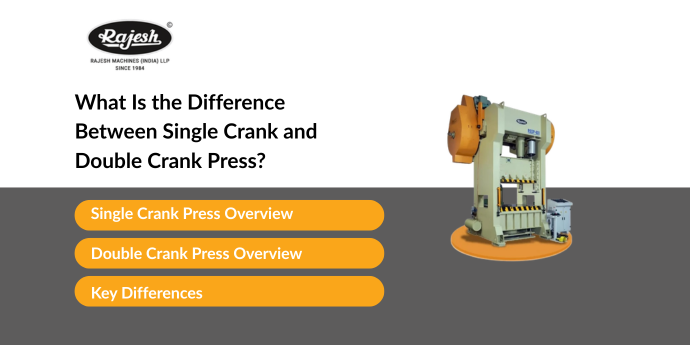
What Is the Difference Between Single Crank and Double Crank Press?
Introduction
Once you start comparing power press specifications, you’ll run into terms like “single crank,” “double crank,” and “double point” fairly quickly, and they don’t always get explained clearly. The difference isn’t just terminology — it comes down to how the slide is actually driven, and that has a real effect on bed width, load distribution, and what size of die and workpiece the press can handle accurately. This post breaks down the mechanical difference in plain terms and helps you figure out which one fits your fabrication work.
What Is a Single Crank Press?
A single crank press uses one crankshaft with a single connecting rod (or pitman) driving the slide from one central point. The crankshaft, powered by the flywheel and clutch, rotates and converts that rotational motion into the up-and-down stroke of the slide through this single drive point.
This is the simplest and most common press configuration, and it works well for smaller to mid-range tonnage machines like C-frame and H-frame power presses. Because the drive point sits centered under the slide, single crank presses perform best when the die and load are also centered. Push the load significantly off-center on a single-point drive, and you can get slight slide tilt, which affects part accuracy over time and puts uneven wear on the gibs and guide surfaces.
What Is a Double Crank (Double Point) Press?
A double crank press, more precisely called a double point press, drives the slide from two points instead of one. This is usually achieved in one of two ways:
- Single crank shaft with two crank throws (double point): one crankshaft with two offset crank pins, each driving its own connecting rod, positioned at two points across the width of the slide.
- Twin crankshaft design (true double crank): two separate, mechanically synchronized crankshafts, each with its own connecting rod, working in unison to drive the slide from both sides.
In everyday shop-floor language, both setups tend to get called “double crank” or “double point” presses somewhat interchangeably, since the practical result is the same either way — the slide is supported and driven from two points across a wider bed rather than one point in the center.
The Core Difference: Force Distribution Across the Bed
This is really what the single crank vs double crank comparison comes down to. A single-point drive concentrates force at the center, which works fine on a narrower bed with centered dies. A double-point drive spreads that force across two points, which keeps the slide level and stable even on a wider bed or when the die isn’t perfectly centered.
Think of it like carrying a long plank of wood. Carry it with one hand in the middle, and it’s manageable as long as the weight is balanced — but shift the load to one end, and the plank tips. Carry it with two hands spread apart, and it stays level even if the weight isn’t perfectly centered. That’s essentially what a double point drive does for the slide on a wide power press.
Side-by-Side Comparison
| Factor | Single Crank Press | Double Crank (Double Point) Press |
|---|---|---|
| Drive points | One, centered | Two, spread across the slide width |
| Best suited bed width | Narrower to moderate | Wider beds |
| Off-center load handling | More prone to slide tilt | More stable under off-center loading |
| Typical tonnage range | Lower to mid-range | Mid to high tonnage, wider ram areas |
| Mechanical complexity | Simpler | More complex, more components to maintain |
| Common configurations | C-frame, H-frame power press | Wider-bed pneumatic and mechanical presses |
| Upfront cost | Generally lower | Generally higher |
Why Bed Width and Tonnage Push You Toward Double Point
As tonnage and bed width increase, a single-point drive starts to struggle to keep the slide perfectly level across the full width, especially under dies that aren’t centered. This becomes a real accuracy problem once you’re running wider ram areas and heavier tonnage, which is exactly where double point presses take over.
For reference, Rajesh Machines’ Single Crank Double Point Pneumatic Press range runs from 110 tons up to 315 tons, with ram areas scaling from roughly 1100mm x 600mm on the smaller model up to 2150mm x 1150mm on the largest. At that kind of bed width, a single centered drive point simply isn’t practical for maintaining consistent slide level across the full working area, which is exactly the gap the double point drive is built to close.
Key Features That Make a Double Point Press Work Reliably
A well-built double point press isn’t just about adding a second drive point — the supporting systems matter just as much:
- Motorized slide adjusting device with digital die height indicator, so operators can dial in precise, repeatable die height across the wider bed
- Long hexagonal gibs with alloy bronze lining to keep the slide running true along its full width without losing adjustment over time
- High-quality crank shaft with outstanding rigidity to maintain accuracy under sustained load
- Dual safety valve with an interlock mechanism to keep the clutch and brake from mis-actuating
- Hydraulic overload protector to prevent the tonnage rating from being exceeded and protect both press and tooling
- Auto lubrication system to keep the additional moving parts properly maintained without relying on manual greasing
When Should You Use a Single Crank Press?
- Centered die work where the load is applied consistently near the middle of the bed
- Smaller to mid-range tonnage requirements, typically under the ranges where bed width starts becoming a real accuracy concern
- General job shop fabrication with varied part sizes that don’t require an especially wide bed
- Lower upfront investment, since single crank presses are mechanically simpler and generally cost less than an equivalent-tonnage double point machine
When Should You Use a Double Crank (Double Point) Press?
- Wide bed, wide-part production where the ram area needs to support dies and workpieces spread across a larger working surface
- Off-center or multi-station die work, where load isn’t applied evenly in the center and slide stability across the full width matters
- Higher tonnage applications where a single centered drive point would be more prone to slide tilt under load
- Production runs demanding tight, repeatable die height across the full bed width, not just at the center
Choosing Between the Two: A Simple Way to Decide
Ask yourself where your dies actually sit on the bed, and how wide your typical workpiece is. If your work is generally centered and your tonnage requirement is moderate, a single crank press is usually the more cost-effective, practical choice. If you’re running wider dies, off-center loading, or higher tonnage work where slide stability across the full bed matters, a double point press is worth the extra investment, since the accuracy and consistency it delivers directly affects part quality and tooling life.
Single Crank Double Point Pneumatic Presses From Rajesh Machines Middle East
At Rajesh Machines, we manufacture Single Crank Double Point Pneumatic Presses from 110 tons up to 315 tons, built on a stress-relieved, weld-free frame with a high-precision transmission gear system, motorized slide adjustment, digital die height indicator, and a fail-safe pneumatic dry clutch and brake combination as standard. Every machine includes PLC control with fault-finding, hydraulic overload protection, and an auto lubrication system to keep the press running reliably across its wider working bed.
With over 36 years of manufacturing experience and more than 50,000 machines installed globally, our team can help you determine whether your production actually calls for a double point drive or whether a standard single crank C-frame or H-frame press covers your needs just as well, at a lower investment. Get in touch with our team in Sharjah for a consultation.
Conclusion
The difference between a single crank and a double crank (double point) press comes down to one thing: how many points are driving and supporting the slide, and how that affects stability across the bed. A single crank press keeps things simple and cost-effective for centered, moderate-tonnage work, while a double point press spreads the load across two drive points to maintain accuracy on wider beds and higher tonnage applications. Match the choice to your actual bed width, die positioning, and tonnage requirements, and the decision usually becomes straightforward.
Frequently Asked Questions
Is a double crank press always better than a single crank press?
Not necessarily. For centered, moderate-tonnage work on a narrower bed, a single crank press is often the more practical and cost-effective choice. Double point presses earn their higher cost specifically on wider beds or off-center loading.
What’s the actual difference between “double crank” and “double point”?
Technically, “double point” typically refers to a single crankshaft with two crank throws, while “true double crank” uses two separate synchronized crankshafts. In practice, both terms are often used interchangeably since the functional benefit — driving the slide from two points — is the same.
What tonnage range typically needs a double point press?
There’s no strict cutoff, but as bed width and tonnage increase, a single centered drive point becomes more prone to slide tilt. Rajesh’s double point range starts at 110 tons and scales up to 315 tons for wider ram areas.
Does a double point press need more maintenance than a single crank press?
It has more moving parts, so routine checks on both drive points, the gib lining, and the crankshaft synchronization matter more than on a single crank press. A standard auto lubrication system helps keep maintenance manageable.
How do I know which one my shop needs?
Look at your typical bed width, whether your dies sit centered or off-center, and your tonnage requirements. Our team can walk through your specific parts and production volume to recommend the right configuration.