
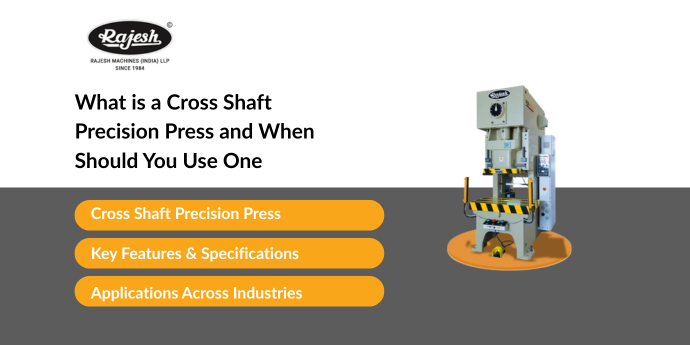
What is a Cross Shaft Precision Press and When Should You Use One
Introduction
Most fabricators are familiar with the usual lineup of press machines — C-frame, H-frame, hydraulic, pneumatic. The cross shaft precision press doesn’t get talked about nearly as often, but for shops running high-speed, high-precision blanking and stamping work, it’s often the machine that actually gets the job done right. This post breaks down what a cross shaft precision press actually is, how its design differs from a standard power press, and the situations where it genuinely earns its place over other options.
What Is a Cross Shaft Precision Press?
A cross shaft precision press is a mechanical power press built around a cross shaft drive system paired with a pneumatic dry clutch. Instead of relying on a single crankshaft the way a standard power press does, the cross shaft design distributes drive across the machine in a way that delivers smoother, more balanced slide motion, particularly at higher strokes per minute. That balanced motion is exactly what makes it suited to precision work — parts that demand tight repeatability, clean edges, and consistent die height cycle after cycle.
The “precision” in the name isn’t just marketing. These presses are built with features specifically aimed at maintaining accuracy at speed: a motorized slide adjustment system, a digital die height indicator reading in 0.1mm increments, long hexagonal gibs with alloy bronze lining to keep the slide running true, and a properly sized, balanced flywheel that stores and releases energy smoothly through each cycle.
How the Pneumatic Dry Clutch Changes Things
One of the defining features of a cross shaft precision press is its pneumatic dry clutch and brake combination. Unlike a mechanically actuated clutch, a pneumatic dry clutch gives fail-safe, precise control over slide motion even when the machine is running at high speed. Combined with a dual safety valve that interlocks the clutch and brake to prevent mis-actuation, this setup is what allows the press to run reliably at higher SPM (strokes per minute) without sacrificing control over exactly where and how the slide stops.
For context, cross shaft precision presses in Rajesh’s range run fixed strokes at speeds up to around 200 SPM on smaller tonnage models, with variable speed options extending that range further. That kind of throughput simply isn’t practical on a standard clutch design without giving up precision.
Key Features That Set It Apart
High-Precision Transmission Gear
The gear system driving the cross shaft is machined to close tolerances, which keeps the press running smoothly and quietly even at sustained high speed — a detail that matters both for part quality and for operator comfort over a full shift.
Motorized Slide Adjustment
Rather than manually cranking the slide up or down between die changes, a motorized slide adjustment device (driven by a thin brake motor and operated with push buttons) gives quick, stable, repeatable positioning. Paired with the digital die height indicator, operators can dial in exact die height without the guesswork that comes with manual adjustment.
Hydraulic Overload Protector
Precision presses still deal with the same overload risks as any power press. A hydraulic overload protector prevents the tonnage rating from being exceeded and protects both the press and the tooling from damage, with a simple reset process that gets the machine back into production quickly after a trip.
Auto Lubrication System
An auto lubrication system with default monitoring keeps critical moving parts properly lubricated without relying on manual greasing schedules, which matters more on a machine running at higher cycle counts.
Anti-Repeat Safety Device and Fault-Finding PLC
Standard safety features include an anti-repeat safety device to prevent unintended double strokes, along with a PLC control system with built-in fault finding, which helps operators and maintenance staff diagnose issues fast instead of guessing at what tripped the machine.
Tonnage and Speed Range
Cross shaft precision presses typically come in a tonnage range from around 25 tons up to 250 tons, giving shops flexibility across a fairly wide span of part sizes and forming forces. As tonnage increases, fixed stroke length and die height also scale up, while maximum SPM generally decreases — smaller tonnage models are built to run fast on smaller parts, while higher tonnage models trade some speed for the capacity to handle larger, heavier forming work.
This range means the “right” cross shaft press really depends on your specific part size and cycle time targets rather than tonnage alone. A shop running small, high-volume components benefits from a lower tonnage model running near its top SPM rating, while a shop forming larger precision parts needs to prioritize tonnage and die height over raw speed.
When Should You Use a Cross Shaft Precision Press?
High-Speed, High-Volume Blanking and Stamping
If your production involves running the same part over and over at high volume — connector components, terminals, small brackets, electrical and electronic parts — a cross shaft precision press is built exactly for that kind of repetitive, high-SPM work.
Applications Demanding Tight Die Height Control
Parts with strict dimensional tolerances benefit from the motorized slide adjustment and digital die height indicator, which let operators hold consistent die height far more precisely than manual adjustment on a standard power press.
Long Production Runs Where Consistency Matters More Than Flexibility
Because cross shaft presses are optimized for speed and repeatability rather than open accessibility or maximum flexibility, they make the most sense when you’re running long batches of a similar part rather than constantly switching between very different jobs.
Precision Component Manufacturing
Industries like electronics, automotive terminals and connectors, and small precision hardware components rely on this type of press because edge quality and dimensional consistency directly affect whether the part functions correctly downstream.
When a Different Press Makes More Sense
A cross shaft precision press isn’t the right fit for every job, and it’s worth being honest about that.
- General job shop work with varied part sizes and low volume is usually better served by a standard C-frame or H-frame power press, which offers more open access and doesn’t require the same investment for capability you won’t fully use.
- Heavy forming or deep drawing where you need controlled, even force through a longer stroke is typically better handled by a hydraulic press, since hydraulic systems maintain constant force throughout the stroke in a way mechanical presses don’t.
- Low-volume prototyping or one-off parts rarely justifies the cost premium of precision high-speed tooling and machine capability that a cross shaft press is built around.
Optional Features Worth Considering
Depending on your production requirements, a few optional additions can extend what the base machine handles:
- Pneumatic die cushion for applications needing controlled counter-pressure during forming
- Variable speed drive for shops that need to adjust cycle speed across different jobs on the same machine
- Photo safety curtains for an added layer of operator protection during high-speed cycling
- Quick die changer to cut changeover time on shops running multiple part numbers through the same press
- Power take-off shaft and inclinable type configuration for specific material handling or feed setups
Cross Shaft Precision Presses From Rajesh Machines Middle East
At Rajesh Machines Middle East, we manufacture cross shaft precision presses across a 25 to 250 ton range, built on a stress-relieved, weld-free frame with high-precision transmission gearing, motorized slide adjustment, and a fail-safe pneumatic dry clutch and brake system as standard. Every machine includes a digital die height indicator, hydraulic overload protection, and PLC control with fault-finding to keep production running with minimal downtime.
With over 36 years of manufacturing experience and more than 50,000 machines installed globally, our team can help you match tonnage, stroke, and SPM rating to your actual part and volume requirements. Browse our Cross-Shaft Precision Press page for full technical specifications, or get in touch with our team in Sharjah for a consultation.
Conclusion
A cross shaft precision press earns its place on a shop floor when the job genuinely calls for high-speed, high-precision, repetitive stamping or blanking — the kind of work where die height consistency and cycle speed directly affect part quality and output. It’s not built to replace your general-purpose power press or your hydraulic press for heavier forming; it’s built to do one thing extremely well. If your production fits that profile, matching tonnage and SPM to your specific part is what determines whether the machine becomes exactly the tool your line needed.
Frequently Asked Questions
What makes a cross shaft precision press different from a standard power press?
The cross shaft drive design delivers smoother, more balanced slide motion at higher speeds, paired with features like motorized slide adjustment and a digital die height indicator that support tighter dimensional control than a standard crankshaft-driven power press.
What industries typically use cross shaft precision presses?
Electronics manufacturing, automotive terminal and connector production, and other high-volume precision component manufacturing are common users, since these applications need both high cycle speed and consistent dimensional accuracy.
Is a cross shaft precision press better than a hydraulic press?
It depends on the application. Cross shaft precision presses excel at high-speed, high-volume blanking and stamping, while hydraulic presses are better suited to heavier forming and deep drawing work that requires constant force through a longer stroke.
What tonnage range should I consider?
Rajesh’s cross shaft precision press range runs from 25 to 250 tons. Smaller tonnage models generally run at higher SPM for smaller parts, while higher tonnage models handle larger parts at a somewhat lower cycle speed. Our team can help match tonnage to your specific part and volume.
Does a cross shaft precision press need special maintenance?
It includes a standard auto lubrication system to reduce manual maintenance, but routine checks on the pneumatic dry clutch, safety valve, and gib lining are still important to maintain accuracy at high cycle counts.