
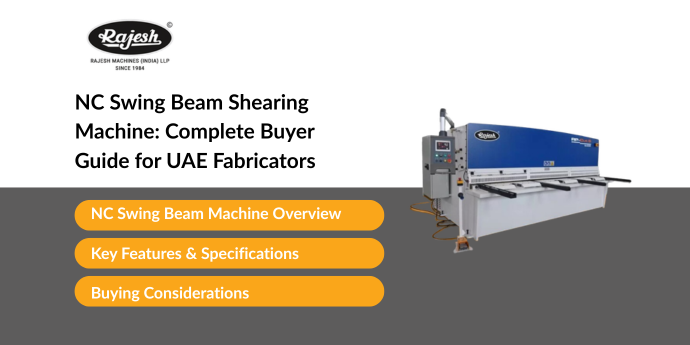
NC Swing Beam Shearing Machine: Complete Buyer Guide for UAE Fabricators
Introduction
If you run a sheet metal fabrication shop in the UAE, sooner or later the shearing machine conversation comes up. Cutting sheet accurately, quickly, and without wasting material has a direct effect on your bottom line. And among the various options available, the NC swing beam shearing machine stands out as the go-to choice for fabricators who need repeatable accuracy without the higher cost of a full CNC system. This guide walks you through everything a UAE fabricator should know before buying one — from how the machine works to which specifications actually matter for your shop floor.
What is an NC Swing Beam Shearing Machine?
An NC swing beam shearing machine cuts flat sheet metal using an upper blade that swings down in an arc against a fixed lower blade, similar to a giant pair of scissors. The “NC” stands for numerical control, which means the back gauge position, cutting length, and cutting programs are set electronically instead of being adjusted manually for every job.
Unlike a fully manual shear where operators measure and reposition the gauge by hand, an NC swing beam shear lets you punch in a cutting length once, save it, and recall it instantly the next time that job comes around. This is what makes it popular in job shops and production units that handle repeat orders or varying batch sizes.
How the Swing Beam Design Works
The upper beam of the machine is mounted on a pivot point and swings downward in an arc rather than moving in a straight vertical line, which is how a hydraulic guillotine shearing machine typically operates. This swinging action reduces the shearing angle needed and puts less strain on the blades, resulting in a cleaner edge with lower cutting force. The table and cutting beam are usually built from stress-relieved rolled steel plate, and the hold-down mechanism clamps the sheet firmly along its full length before the cut begins, which prevents slippage and keeps the cut line straight.
Why UAE Fabricators Are Choosing NC Swing Beam Shears
The UAE fabrication sector runs on a mix of construction steel work, HVAC ducting, automotive components, and general metal fabrication for infrastructure projects. Most of this work involves cutting sheets of varying thickness and length on a daily basis, which is exactly where an NC swing beam shear earns its keep.
- Faster changeovers between jobs since cutting programs can be stored and recalled instead of measured manually each time
- Consistent accuracy across long production runs, which matters when parts need to match across a batch
- Lower operator dependency, since the machine handles repetitive gauge adjustments instead of relying entirely on operator skill
- Better material yield, because accurate back gauging reduces scrap from mis-cuts
- Reasonable investment compared to full CNC shears, while still delivering most of the accuracy benefits
Key Specifications to Check Before You Buy
This is where most buyers either get it right or end up with a machine that doesn’t quite fit their production. Here’s what to actually look at.
Cutting Thickness and Cutting Width
These two numbers define what the machine can physically cut. Cutting thickness usually ranges from 4mm up to 40mm depending on the model, and cutting width (also called cutting length) can run anywhere from 2500mm to 8000mm. Don’t just match your current requirement — think about the thickest and widest sheet you’re likely to cut over the next few years. Buying a shear that’s exactly sized for today’s work often means an upgrade sooner than expected.
Cutting Angle
The cutting angle, generally between 1°30′ and 4° depending on thickness capacity, determines how the blade approaches the sheet during the cut. Thicker sheets typically need a larger cutting angle to reduce the force required, but a larger angle can also mean slightly more sheet distortion. If your shop cuts a wide range of thicknesses regularly, ask your supplier how the machine’s cutting angle behaves across that range.
Backgauge Range and Repeatability
The back gauge is what makes an NC shear worth buying over a manual one. Look at the backgauge range (commonly 20mm to 750mm or 1000mm depending on model) and confirm the positioning accuracy, which is often around 0.01mm on a properly built machine using a ball screw and polished rod system. This is the number that determines whether your parts come out consistent, batch after batch.
Number of Strokes and Hold-Downs
Strokes per minute affect your cutting throughput, especially on high-volume jobs, while the number of hold-down clamps affects how evenly the sheet is held during the cut — more hold-downs generally means better control on wider sheets, which reduces the risk of the material shifting mid-cut.
Main Motor Power and Overall Weight
Motor power (typically ranging from 5.5kW on smaller models to 90kW on heavy-duty units) needs to match your material intension requirements. Heavier machines with a solid, closed-box table construction also tend to hold accuracy better over years of use, since a rigid frame resists deflection under repeated cutting force.
NC Controller Options: What's the Difference?
The controller is the brain of the machine, and this is one area where buyers often don’t ask enough questions. A few common options you’ll come across:
- Basic NC controllers (like the ESTUN E200-S) offer program memory for multiple jobs, one-side positioning indication, auto reference search, and power-down memorization — solid for shops running standard repeat jobs without needing full programmability.
- Advanced NC/CNC controllers (like the Delem DAC310) add servo control technology, back gauge control by gap or angle, stroke length limitation, and live position visualization — useful if your shop needs tighter process control or handles more complex cutting sequences.
- Compact controllers (like the ELGO P40) work well for single or two-axis control with manual and program set operation, suited to simpler production setups.
Match the controller to how your shop actually works. A high-end controller sitting mostly idle because your jobs don’t need that level of programming is money that could have gone toward a bigger machine instead.
Standard Features That Should Come With Any Good NC Swing Beam Shear
Before finalizing a supplier, check that these are included as standard rather than sold as costly add-ons:
- Multi-edge blades suitable for aluminium, carbon steel, and stainless steel
- Cutting line illumination for accurate positioning during the cut
- Stroke counter for production tracking
- Hydraulic and electrical overload protection
- Squaring arm and front support arm for handling sheets safely
- Adjustable back gauge with retraction features according to blade gap
- Sub-program and programming loop functions for repeat sequences
Optional additions like a pneumatic sheet-supporting system or a table-mounted sheet angle cutting gauge can be worth the extra cost depending on your specific workflow, particularly if you’re regularly cutting large or heavy sheets that need extra support.
Hydraulic System and Build Quality Matter More Than the Spec Sheet Suggests
Two machines with identical cutting thickness and width numbers can perform very differently depending on build quality. Pay attention to:
- Frame construction — a frame fabricated from stress-relieved rolled steel plate with an interlocked, weld-free design at load points holds accuracy far longer than a lighter, welded frame.
- Hydraulic system — compact hydraulic blocks reduce leakage points and pipe runs, and a quality pump matched to a reputable motor keeps pressure consistent under load, which directly affects cut quality over the machine’s lifespan.
- Blade material — blades manufactured from proper tool steel grades with controlled heat-treatment last significantly longer between resharpening or replacement.
- Guide plates — heat-treated steel guide plates that keep the upper beam moving true prevent deflection, which is what keeps your cuts straight even after years of daily use.
Safety Features to Look For
Shearing machines apply serious force, and UAE workplace safety standards expect manufacturers to build in proper protection. Confirm the machine includes:
- Rear safety guard
- Photo safety curtain to prevent hand injuries during operation
- Properly labeled and ferruled electrical control panel for safe fault diagnosis
- Pressure relief valves to protect against hydraulic overload
A machine that skips on these isn’t saving you money — it’s shifting the risk onto your shop floor.
Matching the Machine to Your Production Volume
Job Shops and Mixed Production
If your shop handles varied orders with different sheet sizes and thicknesses, prioritize a machine with a wide backgauge range and flexible program storage. A basic NC controller with good repeatability usually covers this well without overspending on features you won’t use daily.
High-Volume Production Lines
For shops running long batches of identical parts, stroke speed and hold-down consistency become more important than sheer flexibility. Look at models with more hold-down clamps and confirm the stroke count per minute fits your daily output targets.
Heavy Plate Fabrication
If you’re regularly cutting 12mm and above, motor power, frame rigidity, and cutting angle become the deciding factors. These jobs put more strain on the frame and blades, so don’t compromise on build quality here to save a little on upfront cost.
Maintenance Considerations Before You Buy
Ask your supplier about routine maintenance requirements upfront, not after installation. A few things worth checking:
- Availability of spare blades and how often resharpening or replacement is typically needed
- Access to the hydraulic system for servicing without major disassembly
- Local availability of technical support and spare parts in the UAE
- Warranty terms on the hydraulic system and NC controller specifically, since these are the most electronics-heavy components
A shearing machine that’s difficult to service locally can mean costly downtime, even if the machine itself is well built.
Shop NC Swing Beam Shearing Machines From Rajesh Machines Middle East
At Rajesh Machines Middle East, we manufacture NC swing beam shearing machines built on stress-relieved, weld-free frame construction with Bosch Rexroth hydraulic systems and a choice of ESTUN, Delem, and ELGO controllers depending on your production needs. Our shearing machine range covers cutting thicknesses from 4mm to 40mm and cutting widths up to 8000mm, so whether you’re running a small fabrication unit or a heavy plate processing line, there’s a model built for it.
Operating out of Sharjah with over 36 years of manufacturing experience and more than 50,000 machines installed globally, our technical team can help you match specifications to your actual production requirements rather than just selling you the biggest number on the spec sheet. We also support installation, operator training, and after-sales service across the UAE.
Browse our full shearing machine range or get in touch with our team for a consultation before you decide.
Conclusion
An NC swing beam shearing machine is one of those investments that quietly pays for itself through faster changeovers, better material yield, and fewer mis-cuts over time. But getting the right one means looking past the headline cutting thickness number and checking the backgauge accuracy, hydraulic build quality, controller type, and safety features that actually determine how the machine performs day to day. Take the time to match the machine to your real production volume and material range, ask your supplier the right questions about maintenance and local support, and you’ll end up with a shear that serves your shop reliably for years, not just a machine that looked good on paper.