
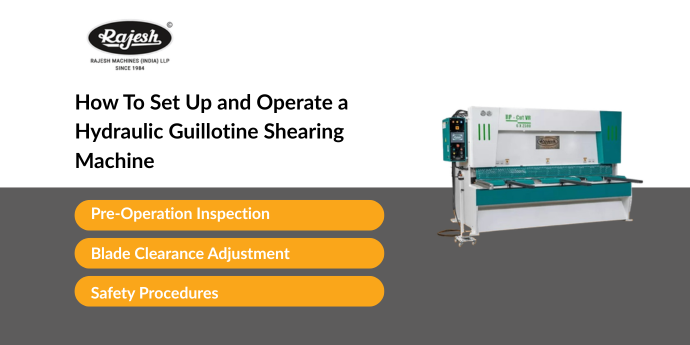
How To Set Up and Operate a Hydraulic Guillotine Shearing Machine
Most Shearing Problems Start Before the First Cut
In most workshops, when a hydraulic shearing machine starts producing bad cuts, operators immediately assume something is wrong with the blade or hydraulic system.
But in reality, the issue usually begins much earlier — during setup.
A wrong blade clearance setting, a slightly misaligned back gauge, or even a sheet placed at a small angle can affect the cut right from the first stroke. And once production starts, operators often end up adjusting random settings without fixing the actual cause.
This guide breaks down how a hydraulic guillotine shearing machine should be set up and operated in real workshop conditions — not textbook theory, but what actually works on the shop floor.
What is a Hydraulic Guillotine Shearing Machine?
A hydraulic guillotine shearing machine is used to cut sheet metal using two blades — one fixed and one moving vertically downward.
The upper blade comes down in a straight motion (like a guillotine), pressing the sheet against the lower blade and shearing it cleanly.
This straight vertical movement is what makes guillotine shears different from swing beam machines, which cut in an arc. That difference matters because it affects cut consistency, especially on wider sheets.
The machine is powered by a hydraulic system, which controls the cutting force and movement of the ram. This gives much better control compared to older mechanical systems.
These machines are widely used in fabrication units, HVAC workshops, steel service centers, and general sheet metal industries. They are suitable for cutting materials like mild steel, stainless steel, and aluminium.
If you compare machine types, the difference between guillotine and swing beam shears becomes very important when choosing equipment for production.
How the Cutting Process Actually Happens Inside a Hydraulic Guillotine Shearing Machine
To understand setup, it helps to first understand what is physically happening during the cut.
When the operator presses the pedal, hydraulic pressure pushes the ram downward. The upper blade moves toward the lower blade, and the sheet is held tightly in place using clamps.
At the moment of cutting, the blades don’t simply “slice” the sheet — they apply shear force. The material fractures along a controlled line between the two blades.
One of the most important factors here is blade clearance — the small gap between upper and lower blades.
If the clearance is correct, the cut is clean with minimal burr. If it’s wrong, you immediately see problems like rough edges, bending, or excessive blade wear.
Once the cut is complete, the ram returns, clamps release, and the sheet is ready for the next operation.
The back gauge decides the cut length. The operator pushes the sheet until it touches the back gauge, and that position determines where the cut will happen. This is what allows repeat accuracy in production.
Before You Start the Machine
Good operators don’t rush into cutting. A few minutes of checking can prevent hours of rework later.
Start with a quick walkaround. Look for oil leakage, loose bolts, or debris on the table. These small things often point to bigger issues.
Next, check hydraulic oil level. Low oil doesn’t just reduce power — it makes machine movement inconsistent.
If the machine has been idle overnight, run a few dry cycles. Cold hydraulic oil behaves differently, and the machine needs a short warm-up before stable operation.
Finally, inspect blade condition. You don’t always need visible damage to have a dull blade. Often, poor cut quality is the first sign.
Step-by-Step Setup for Hydraulic Guillotine Shearing Machine
1. Blade Clearance Setting
This is the most important adjustment on the machine.
Blade clearance is the gap between upper and lower blades. If it is too tight, blades rub and wear quickly. If it is too loose, the sheet bends before cutting and edges become rough.
As a general rule:
- Mild steel: around 5% to 8% of material thickness
- Stainless steel: slightly higher clearance
- Aluminium: slightly tighter setting
Most machines have a dial or manual adjustment system for this. But the actual confirmation should always be done with a feeler gauge, not just the scale marking.
2. Rake Angle
The rake angle is the tilt of the upper blade.
A slight angle helps reduce cutting force because the blade engages gradually instead of hitting the full width at once.
More angle = less force but slightly more distortion on thin strips.
Less angle = cleaner flat cuts but higher force requirement.
In most normal fabrication work, factory settings are already balanced well.
3. Back Gauge Setup
Back gauge is what controls cutting size.
Even a small error here can create batch-wide rejection. That’s why first-piece checking is important.
Always cut one sample piece and measure it before starting full production. Never rely blindly on the digital reading.
If the job is repeated often, it’s useful to note down correct back gauge positions for future use.
4. Hold-Down Pressure
The clamps hold the sheet firmly during cutting.
If pressure is too low, the sheet shifts slightly during the cut. If too high, it can leave marks on softer materials.
A balanced setting ensures stability without damaging the surface.
How to Operate a Hydraulic Guillotine Shearing Machine Safely
Once setup is done, operation should always follow a fixed sequence.
Load the sheet carefully onto the table. Large sheets should never be handled alone — support matters.
Push the sheet until it touches the back gauge properly. Even a slight tilt here can affect the final cut.
Make sure clamps engage before cutting starts. This prevents sheet movement during the stroke.
Use the foot pedal or control system to start the cut. Keep hands away from the cutting zone at all times.
After cutting, handle edges carefully — freshly cut metal is extremely sharp.
Always check the first piece before continuing full production.
The advantages of shearing machines and their safety considerations are worth understanding fully, particularly for workshops where operators rotate between different machine types.
Common Mistakes in Real Workshop Cutting Operations
Most cutting problems are not machine failures, they are setup or handling mistakes.
One of the biggest issues is wrong blade clearance when switching materials. Operators often forget to adjust it.
Another common problem is misaligned sheet feeding. Even a small angle leads to inaccurate cuts across long lengths.
Back gauge drift is also common in older machines. That’s why periodic checking is important.
And finally, pushing machines beyond rated capacity leads to faster blade wear and hydraulic stress.
Understanding the basics of shearing machines includes the hydraulic system fundamentals that matter for this.
Why Blade Clearance Matters So Much in Shearing Quality
Blade clearance affects everything — edge quality, machine load, and blade life.
When it’s correct, the material fractures cleanly between blades.
When it’s too tight, the blades scrape and overheat.
When it’s too loose, the sheet bends before breaking, which creates rough edges and inconsistent cuts.
In most troubleshooting cases, blade clearance is the first thing worth checking.
Hydraulic vs Mechanical Shearing Machines: Key Differences Explained
Hydraulic guillotine shears offer more flexibility because force and stroke can be controlled.
Mechanical shears are faster but less flexible, as they rely on fixed motion from a flywheel system.
For varied thickness jobs, hydraulic machines are more practical. For high-speed repetitive cutting, mechanical systems still have their place.
Basic Maintenance That Prevents Downtime and Improves Machine Life
Good maintenance is simple but often ignored.
Hydraulic oil should be clean and changed at proper intervals. Dirty oil is one of the biggest reasons for inconsistent machine behaviour.
Blades should be rotated before they become completely dull. Most blades have multiple usable edges.
Back gauge screws should be lubricated regularly to avoid positioning errors.
The machine table should always be kept clean to ensure proper sheet alignment.
The future of hydraulic shearing machines points toward machines with built-in monitoring for blade wear and hydraulic system health — useful developments for production environments where unplanned downtime is expensive.
Warning Signs You Should Not Ignore in Shearing Machine Performance
If cut sizes start varying, back gauge may be misaligned.
If edges become rough, check blade clearance or blade condition.
If cuts are not square, sheet feeding alignment is likely wrong.
If the machine feels sluggish, hydraulic pressure or oil condition may be the issue.
These problems don’t fix themselves — early correction always saves cost.
Final Thoughts
A hydraulic guillotine shearing machine is not difficult to operate, but it does demand correct setup.
Once blade clearance, back gauge, and alignment are properly handled, the machine will deliver consistent results for a long time.
Most quality issues don’t come from the machine — they come from small setup errors that get ignored.
If you treat setup seriously, production becomes predictable, faster, and far more efficient.
Need a Hydraulic Guillotine Shearing Machine?
Rajesh Power Press supplies hydraulic guillotine shearing machines and complete sheet metal fabrication equipment across UAE and GCC.
If you’re planning a new setup or upgrading an existing line, our team can help you choose the right specification for your production needs.