
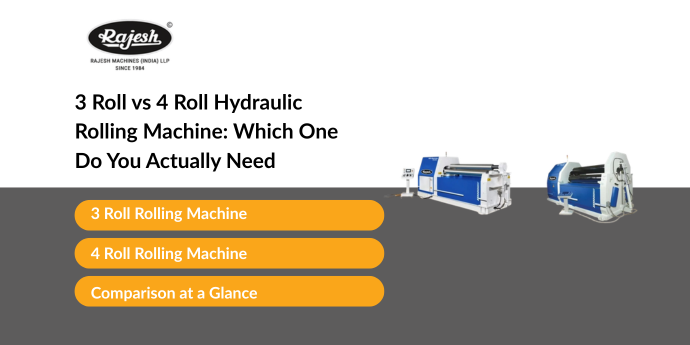
3 Roll vs 4 Roll Hydraulic Rolling Machine: Which One Do You Actually Need
Introduction
Ask five fabricators which is better, a 3 roll or a 4 roll hydraulic rolling machine, and you’ll probably get five different answers. That’s because there isn’t one correct answer — there’s only the right answer for what you’re actually rolling day to day. Both machines bend flat sheet and plate into curved and cylindrical shapes, but the way they do it, and what that means for your finished part, is quite different. This guide breaks down exactly how each configuration works, where they genuinely differ, and how to figure out which one fits your shop without paying for capability you’ll never use.
The Core Difference: How Each Machine Bends Metal
3 Roll Rolling Machine
A 3 roll hydraulic rolling machine uses two bottom rolls that support and drive the sheet, and one top roll that presses down to create the bend. This is what’s called a pyramid configuration, and it’s the design most fabrication shops grew up on. The sheet is fed between the rolls, the top roll applies pressure, and the plate is passed through repeatedly until the desired curve is achieved.
The catch with a 3 roll setup is the leading and trailing edges of the plate. Because the bottom rolls need a certain amount of material to grip and support, the last section near each edge often doesn’t get bent as tightly as the rest of the sheet, leaving a small flat spot. Operators usually deal with this by flipping the plate and pre-bending the edges in a separate pass, or by using a pre-pinch feature if the machine has one.
4 Roll Rolling Machine
A 4 roll hydraulic rolling machine adds a second driven roll and typically also uses side rolls (in addition to the top and bottom rolls) that move in to pre-bend both edges of the plate before the main rolling pass even begins. This is the real advantage of the 4 roll design — it handles pre-pinching automatically as part of the process, instead of requiring a separate manual step.
Because the plate is clamped and driven from both sides, a 4 roll machine also tends to hold the sheet more securely through the entire cycle, which translates into more consistent, repeatable curves, especially on longer production runs.
Side-by-Side Comparison
| Factor | 3 Roll Machine | 4 Roll Machine |
|---|---|---|
| Roll configuration | 2 bottom rolls + 1 top roll (pyramid) | Top, bottom, and 2 side rolls |
| Edge pre-bending | Manual or separate pass required | Built into the rolling cycle |
| Flat spots on edges | More likely without pre-pinching | Minimized automatically |
| Operator skill needed | Moderate to high for consistent edges | Lower, since the machine handles pre-bend |
| Cycle time per part | Longer with edge pre-bending steps | Shorter, fewer passes needed |
| Repeatability on batch runs | Good, but depends on operator technique | Higher, less variation part to part |
| Upfront investment | Lower | Higher |
| Best suited for | General fabrication, job shops with varied work | Precision cylinders, thicker plate, high-volume runs |
Where a 3 Roll Machine Makes More Sense
A 3 roll hydraulic rolling machine is still a solid choice for a lot of fabrication work, and it’s not simply the “budget” option — it’s genuinely the right tool for certain jobs.
- Mixed, varied production where you’re rolling different thicknesses and diameters throughout the week, and don’t need every part to be perfectly edge-to-edge accurate
- General ductwork, tanks, and architectural panels where a small flat spot at the seam isn’t going to cause a functional problem, especially since the seam area often gets welded and finished anyway
- Shops with experienced operators who already know how to compensate for edge flattening through technique, like flipping the plate or running an extra pass
- Lower upfront budget, since 3 roll machines are generally priced lower than an equivalent-capacity 4 roll model
Rajesh Machines’ 3 roll hydraulic rolling range covers rolling widths from 1600mm up to 4100mm, with rolling capacities from 4mm to 30mm depending on the model, and comes standard with double hydraulic pre-pinch, a 7-inch touchscreen HMI, and a planetary gearbox setup that keeps the machine running efficiently under full load.
Where a 4 Roll Machine Earns Its Higher Price Tag
There are jobs where a 4 roll machine isn’t a luxury, it’s a requirement.
- Pressure vessels and tanks where the entire circumference needs to be within tight tolerance, since inconsistent curvature can affect how the cylinder holds pressure once seams are welded
- Thicker plate work where manually pre-bending edges on a 3 roll machine would be slow, physically demanding, or simply impractical at that thickness
- High-volume production where shaving even a couple of minutes off each cycle by skipping a manual pre-bend step adds up significantly across a full shift
- Shops running less experienced operators, since the 4 roll design does more of the accuracy work automatically instead of relying on operator judgment
- Jobs with strict edge tolerance specs, particularly in shipbuilding, oil and gas, and structural fabrication where flat spots simply aren’t acceptable
Rajesh Machines’ 4 roll hydraulic rolling machines range from compact 1250mm rolling width models up to heavy-duty 4100mm units, with capacities up to 30mm, and come standard with 4 roll double hydraulic pre-pinch, 6 high-precision linear scales, and a movable operator panel with synchro and non-synchro roll control.
Plate Thickness and Rolling Width: Matching Capacity to Your Work
Both machine types come in a wide range of capacities, so “3 roll vs 4 roll” shouldn’t be the only decision you’re making — the specific model within each type matters just as much.
Look at two numbers together: rolling capacity (the maximum plate thickness the machine can roll in mild steel at full rated capacity) and rolling width (how long a sheet the machine can handle). A machine rated for 6mm capacity at 4100mm width behaves very differently from one rated for 20mm at the same width, even though both are technically “4 roll machines.” Match the model to the thickest, widest plate you realistically expect to run — not just your average job — since upgrading a machine later is a far bigger expense than sizing correctly the first time.
Also check the minimum plate thickness the machine can roll, which is typically listed as a percentage of rated capacity. If your shop regularly works with thin gauge sheet as well as heavier plate, confirm the machine you’re considering handles that full range well, not just the top end of its rated capacity.
Pre-Pinch Capacity: The Number Buyers Often Skip
Pre-pinching capacity — how thick a plate the machine can grip and pre-bend before the main rolling pass — is usually listed separately from rolling capacity, and it’s worth paying attention to. On both 3 roll and 4 roll machines from Rajesh, pre-pinch capacity generally sits a step below full rolling capacity. If your work regularly involves plate near the top of a model’s rated thickness, check that its pre-pinch rating still comfortably covers what you’re feeding through, since undersized pre-pinch capacity is one of the more common reasons shops end up dealing with edge flat spots even on a 4 roll machine.
Gearbox, Motor, and Control System
Both configurations from Rajesh Machines use a planetary gearbox setup powered by individual hydro motors, which allows the machine to run at full capacity without overloading and keeps torque consistent through the rolling cycle. Main pump motor power scales with model size, running from around 2HP on smaller units up to 30HP on the largest heavy-duty machines.
Control-wise, both ranges come standard with a 7-inch Delta colour touchscreen HMI and a Schneider PLC control panel with programming facility, so operators can set and recall roll positions rather than adjusting everything manually each time. The 4 roll range adds a movable operating panel with dedicated controls for synchro and non-synchro roll movement, drop end open/close, and graphical roll position display, which reflects the more complex coordination needed to run four rolls in sync.
Maintenance and Long-Term Running Costs
A 4 roll machine has more moving parts, which means more components to maintain — two additional side rolls, their hydraulic cylinders, and the additional linear scales that track their position. That said, both machine types use a centralized auto lubrication system as standard, which significantly cuts down on manual greasing and keeps bearing wear predictable.
Ask your supplier about local availability of spare bearings, hydraulic seals, and linear scale components before you buy either type. A more complex machine sitting idle waiting for a part from overseas costs you far more in downtime than the price difference between 3 roll and 4 roll ever will.
A Simple Way to Decide
If you’re still not sure which one fits your shop, ask yourself these questions:
- Does my work involve pressure vessels, tanks, or anything with strict edge-to-edge tolerance? If yes, lean 4 roll.
- Am I regularly rolling plate above 12-16mm thickness? If yes, the automatic pre-pinch on a 4 roll machine will save real time and physical strain.
- Is my production high-volume and repetitive, or varied and job-shop style? High-volume repeat work favors 4 roll; varied general fabrication often works fine on 3 roll.
- Do I have operators who are experienced at compensating for edge flattening? If not, the 4 roll machine reduces how much depends on operator skill.
- What’s my budget, and how does the cost difference compare to what I’d save in cycle time and scrap? For some shops, the payback period on a 4 roll machine is short. For others, a well-specified 3 roll machine is the smarter buy.
Shop 3 Roll and 4 Roll Rolling Machines From Rajesh Machines Middle East
At Rajesh Machines Middle East, we manufacture both 3 roll hydraulic rolling machines and 4 roll hydraulic rolling machines across a wide range of rolling widths and plate capacities, built with planetary gearboxes, centralized auto lubrication, and PLC-controlled touchscreen operation as standard. With over 36 years of manufacturing experience and more than 50,000 machines installed worldwide, our team can walk you through the real trade-offs between the two configurations based on the plates you actually roll, not just the spec sheet.
We also supply the 3 roller mechanical rolling machine for shops that don’t need hydraulic control, along with optional features like conical bending devices, oil coolers, and motorized feed tables for both the 3 roll and 4 roll ranges.
Get in touch with our team in Sharjah for a consultation, and we’ll help you match the right configuration and capacity to your production line.
Conclusion
Neither the 3 roll nor the 4 roll hydraulic rolling machine is objectively better — they’re built to solve slightly different problems. A 3 roll machine gives you a reliable, cost-effective way to handle general fabrication work, especially when your operators know how to work around edge flattening. A 4 roll machine takes that manual step out of the equation, delivering tighter, more consistent curves automatically, which matters most when you’re working with pressure vessels, thicker plate, or high-volume production where every extra minute per part adds up. Look at what you’re actually rolling, how tight your tolerances need to be, and how experienced your operators are, and the right choice usually becomes pretty clear.
Frequently Asked Questions
Can a 3 roll machine achieve the same accuracy as a 4 roll machine?
With a skilled operator and proper technique, a 3 roll machine can produce good results, but it generally requires more passes and manual edge pre-bending to match the consistency a 4 roll machine delivers automatically.
Is a 4 roll machine always the better investment?
Not necessarily. If your work is varied, general fabrication without strict edge tolerance requirements, the extra cost of a 4 roll machine may not pay back quickly. It depends on your specific production mix.
What plate thickness typically requires a 4 roll machine?
There’s no strict cutoff, but as plate thickness increases, manually pre-bending edges on a 3 roll machine becomes more time-consuming and physically demanding, which is where the 4 roll’s automatic pre-pinch starts to matter more.
Do both machine types handle stainless steel and aluminum?
Yes, both 3 roll and 4 roll hydraulic rolling machines can handle stainless steel and aluminum, though thicker or harder materials generally need more rolling passes and careful roller adjustment regardless of configuration.
How do I know what rolling width and capacity I need?
Base it on the widest and thickest plate you realistically expect to roll, not just your average job. Our team can help match a specific model’s rolling capacity, width, and pre-pinch rating to your actual production requirements.