
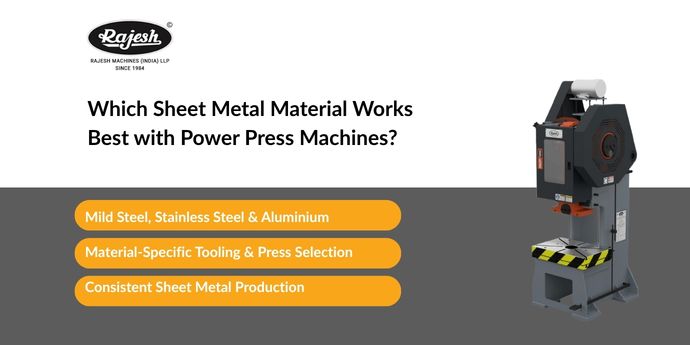
Choosing the right sheet metal material for a power press machine affects forming quality, tool life, production speed, and finished component accuracy. Different metals respond differently to punching, blanking, bending, and forming because their strength, thickness, ductility, and hardness vary.
There is no single sheet metal material that works best for every power press application. The right choice depends on the component design, required operation, material thickness, production volume, and power press capacity.
For manufacturers using a power press machine for sheet metal fabrication, understanding how different materials behave helps improve production planning and tooling selection.
What Makes a Sheet Metal Material Suitable for a Power Press?
Before choosing a material, manufacturers should evaluate several properties.
Material Strength
Higher-strength materials require greater force during punching and forming. The power press must have sufficient capacity for the selected material and thickness.
Ductility
Ductile materials generally deform more easily without cracking. This is important for forming operations where the sheet undergoes significant deformation.
Thickness
Sheet thickness directly affects the force required for cutting and forming. Thicker sheets typically require greater press capacity and appropriately rated tooling.
Hardness
Harder materials often increase tool loading and wear. Tool material, clearance, and machine capacity should be considered accordingly.
Surface Condition
Surface quality also matters for applications where the finished component requires a clean appearance or where surface defects could affect subsequent processing.
Common Sheet Metal Materials Used with Power Press Machines
1. Mild Steel
Mild steel is one of the most widely used materials for power press applications.
It offers a practical combination of strength, ductility, availability, and cost. It is commonly used for components produced through punching, blanking, bending, and forming.
Typical applications include:
- Brackets
- Mounting plates
- Automotive components
- Electrical enclosures
- Hardware components
- Industrial parts
For general-purpose power press work, mild steel is often a practical starting point because it is relatively easy to process when the material thickness and tooling are properly matched.
2. Stainless Steel
Stainless steel is used when corrosion resistance, durability, or appearance is important.
However, stainless steel generally requires more careful process planning than mild steel. Its strength and work-hardening behaviour can increase forming forces and tool wear.
Power press applications include:
- Industrial components
- Kitchen equipment
- Electrical parts
- Automotive components
- Chemical equipment components
Correct tooling clearance and press capacity are important when working with stainless steel.
3. Aluminium
Aluminium is lightweight and offers good corrosion resistance. Its low density makes it useful where reducing component weight is important.
It is commonly used for:
- Lightweight enclosures
- Automotive components
- Electrical components
- Consumer products
- Aerospace-related parts
Because aluminium is softer than many steels, tooling and handling should be selected to avoid unnecessary surface damage.
4. Copper
Copper is valued for its excellent electrical and thermal conductivity.
Power presses are used to produce copper components such as:
- Electrical terminals
- Connectors
- Busbar components
- Electrical contacts
- Conductive parts
Copper’s material properties need to be considered when selecting tooling and press parameters, particularly for thin precision components.
5. Brass
Brass combines good machinability, corrosion resistance, and electrical conductivity.
It is used for smaller components such as:
- Electrical terminals
- Connectors
- Fittings
- Hardware
- Decorative components
Brass is suitable for many punching and forming applications when the material grade, thickness, tooling, and press capacity are correctly matched.
Mild Steel vs. Stainless Steel vs. Aluminium
For manufacturers deciding which material to use, the choice should be based on the component’s functional requirements rather than press compatibility alone.
| Material | Key Advantage | Typical Power Press Applications |
|---|---|---|
| Mild steel | Strength and cost-effectiveness | Brackets, panels, industrial components |
| Stainless steel | Corrosion resistance | Industrial and equipment components |
| Aluminium | Low weight | Lightweight enclosures and components |
| Copper | Electrical conductivity | Terminals, contacts, busbars |
| Brass | Conductivity and formability | Fittings, connectors, hardware |
The exact performance depends on the material grade, thickness, tooling, and forming operation.
Which Material Is Best for High-Volume Power Press Production?
For high-volume production, mild steel is often a practical choice for general-purpose components because it combines good availability, strength, and formability.
However, high-volume production does not automatically mean mild steel is the best option.
For example:
- Use stainless steel when corrosion resistance is a priority.
- Use aluminium when low weight is important.
- Use copper for electrical conductivity.
- Use brass for specific electrical and hardware applications.
The material should therefore be selected according to the finished component’s purpose.
How Material Thickness Affects Power Press Selection
Material thickness is one of the most important factors when matching sheet metal with a power press.
As thickness increases, the force required for operations such as punching and blanking also increases. Using a press with insufficient capacity can affect production performance and place excessive loads on the machine and tooling.
Manufacturers should consider:
- Material type
- Material thickness
- Part dimensions
- Punch diameter
- Number of operations
- Required production speed
- Tooling configuration
These factors should be evaluated together when determining the appropriate press capacity.
Choosing the Right Tooling for Different Sheet Metals
The material and tooling need to work together.
Tooling selection should account for:
Clearance
Punch and die clearance should correspond to the material type and thickness. Incorrect clearance can lead to poor edges, excessive burrs, or unnecessary tool wear.
Tool Material
Different materials and production volumes require different tooling considerations. Harder or more abrasive sheet metals can place greater demands on the tooling.
Punch and Die Design
The geometry of the punch and die should match the component design and material characteristics.
Lubrication
Some forming operations require suitable lubrication to reduce friction and support consistent material flow.
How to Improve Power Press Performance with Different Materials
Using the right material is only one part of achieving consistent production.
Manufacturers should also:
- Match press capacity to material thickness.
- Use appropriate punch and die clearance.
- Select tooling according to the material.
- Maintain correct machine alignment.
- Inspect tooling regularly.
- Follow recommended operating parameters.
- Monitor tool wear during high-volume production.
- Use suitable lubrication where required.
- Maintain the power press according to manufacturer recommendations.
These practices help maintain consistent component quality and reduce avoidable tooling and machine problems.
How to Choose the Right Sheet Metal for Your Application
Start with the finished component rather than the machine.
Ask:
- What strength does the component require?
- Does it need corrosion resistance?
- Is low weight important?
- What thickness is required?
- Does the component require punching, blanking, bending, or forming?
- What production volume is expected?
- What tooling is available?
- Does the existing power press have sufficient capacity?
The answers help narrow down the appropriate material and machine configuration.
Conclusion
Mild steel, stainless steel, aluminium, copper, and brass are all suitable for different power press applications. Mild steel is often a practical choice for general-purpose and high-volume sheet metal production, but it is not universally the best material.
The right material depends on the component’s strength, weight, corrosion resistance, electrical properties, thickness, and forming requirements.
At the same time, the power press machine, tooling, material, and production process must be matched as a complete system. Selecting the correct combination helps manufacturers achieve consistent results and efficient sheet metal production.
Frequently Asked Questions
Which sheet metal is easiest to use with a power press?
Mild steel is often relatively straightforward to process because of its combination of strength and formability. The actual suitability depends on grade, thickness, tooling, and operation.
Can stainless steel be used in a power press machine?
Yes. Stainless steel is commonly processed using power presses for punching, blanking, and forming. Its material properties require appropriate press capacity and tooling.
Is aluminium suitable for power press operations?
Yes. Aluminium is suitable for many punching, blanking, and forming applications. Proper tooling and handling help reduce surface damage.
How does sheet thickness affect power press capacity?
Thicker material generally requires greater force for cutting and forming. Press capacity should be selected based on material type, thickness, component design, and the specific operation.
What is the best material for high-volume power press production?
Mild steel is often a practical option for general-purpose high-volume production, while stainless steel, aluminium, copper, or brass are preferable when specific performance properties are required.