
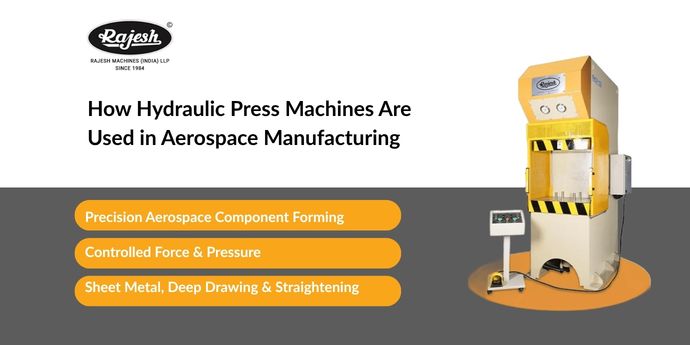
Aerospace manufacturing requires high dimensional accuracy, controlled forming, and consistent production quality. Many aircraft components start as flat metal sheets, plates, or specially prepared blanks and need to be shaped without compromising their structural properties.
A hydraulic press in aerospace manufacturing provides controlled force for forming, bending, pressing, straightening, and other operations. Its ability to apply steady pressure makes it suitable for producing complex metal components used in aircraft and aerospace systems.
The right press depends on the material, component geometry, required force, tooling, production volume, and accuracy requirements.
Why Are Hydraulic Presses Used in Aerospace Manufacturing?
Aerospace components often require controlled forming to achieve the required shape while maintaining material integrity. Hydraulic presses support this process by providing adjustable pressure and controlled ram movement.
Some key advantages include:
- Controlled forming force
- Consistent pressure application
- Adjustable pressing speed
- Suitable for complex forming operations
- Ability to handle different material thicknesses
- Flexibility for different tooling arrangements
- Suitable for low- and medium-volume specialised production
The actual results depend on machine configuration, tooling, material properties, operator expertise, and process control.
How Hydraulic Presses Are Used in Aerospace Manufacturing
1. Forming Aircraft Components
One of the primary applications of hydraulic presses is forming metal components into required shapes.
Aerospace manufacturers work with materials such as aluminium alloys, titanium, and high-strength steels. These materials require appropriate forming parameters based on their mechanical properties.
A hydraulic press applies controlled force through the forming tool to shape the material according to the component design.
2. Sheet Metal Forming
Aircraft structures contain numerous formed sheet metal components. Hydraulic presses support forming operations where a flat sheet needs to be shaped into a three-dimensional component.
The process typically involves:
- Preparing the sheet or blank
- Positioning it correctly in the tooling
- Applying controlled hydraulic pressure
- Forming the material to the required geometry
- Releasing the pressure
- Inspecting the finished component
Proper tooling and process parameters are essential for achieving repeatable results.
3. Deep Drawing
Hydraulic presses are also used for deep drawing applications. Deep drawing transforms a flat metal blank into a deeper component using a punch and die.
The controlled movement of a hydraulic press helps manufacturers manage the forming process and reduce the risk of defects associated with unsuitable forming conditions.
The appropriate press capacity depends on factors such as material type, blank dimensions, thickness, component depth, and tooling design.
4. Straightening Components
Metal components can require straightening after forming, machining, welding, or other manufacturing processes.
A hydraulic press provides controlled force for straightening operations. Operators apply pressure at specific points to bring the component back within the required dimensional tolerance.
This application is useful when working with larger or heavier aerospace components where manual correction is impractical.
5. Assembly and Press-Fitting Operations
Hydraulic presses also support certain aerospace assembly operations where controlled force is required to install or fit components.
Depending on the application, pressing can be used for fitting parts, bushings, bearings, or other components. The required force and tooling depend on the component design and assembly specification.
Aerospace Components Manufactured Using Hydraulic Presses
The exact applications vary between manufacturers and production processes. Hydraulic presses can support the manufacture or forming of components such as:
- Aircraft panels
- Structural components
- Brackets
- Formed sheet metal parts
- Bulkhead components
- Frames and supports
- Engine-related components
- Aerospace equipment housings
- Specialised formed parts
Not every component is produced entirely using a hydraulic press. Aerospace manufacturing typically combines forming with cutting, machining, bending, heat treatment, joining, inspection, and finishing processes.
Materials Used in Aerospace Press Forming
Material selection has a major influence on hydraulic press requirements.
Aluminium Alloys
Aluminium alloys are widely used in aerospace because of their favourable strength-to-weight characteristics. Their forming behaviour depends on the specific alloy and temper.
Hydraulic presses can provide controlled force for forming aluminium components when the tooling and process parameters are properly selected.
Titanium
Titanium offers high strength and corrosion resistance while maintaining relatively low density compared with many steels. However, its forming characteristics require careful process control.
Hydraulic presses with appropriate capacity and tooling support controlled forming operations for titanium components.
High-Strength Steels
Some aerospace applications require high-strength steel components. These materials often require greater forming forces than lighter alloys.
Press capacity, tooling strength, forming speed, and material behaviour need to be considered when processing these materials.
How to Select a Hydraulic Press for Aerospace Manufacturing
Selecting a hydraulic press should begin with the component and process requirements.
Press Capacity
The required tonnage depends on the material, thickness, component geometry, tooling, and forming operation. The machine should provide sufficient force for the intended application without selecting capacity based on guesswork.
Working Area
The bed size and available working space should accommodate the component and tooling arrangement.
Large aerospace components require a press with suitable working dimensions and adequate access for loading and unloading.
Stroke Length
The required stroke depends on the forming operation and tool design. The press should provide sufficient movement for the intended process.
Pressure and Speed Control
Controlled pressure and ram movement are important for forming applications. Adjustable operating parameters provide greater control over different materials and component geometries.
Tooling Compatibility
The press should accommodate the dies, punches, fixtures, and other tooling required for the manufacturing process.
Production Volume
Production requirements also influence machine selection. A press used for specialised aerospace components might have different requirements from equipment used for repetitive high-volume production.
Hydraulic Press vs. Mechanical Press for Aerospace Applications
Both hydraulic and mechanical presses have applications in metal forming, but their operating characteristics differ.
A hydraulic press applies force through a hydraulic system and provides control throughout the stroke. This makes it useful for forming applications where controlled pressure and movement are important.
A mechanical press uses a mechanical drive system and is often preferred for high-speed repetitive operations such as punching and blanking.
The appropriate choice depends on the manufacturing operation, production volume, material, tooling, and component requirements.
For applications requiring substantial forming force and controlled movement, a hydraulic press is often a suitable option.
Importance of Tooling in Aerospace Press Forming
The press itself is only one part of the forming process. Tooling has a major effect on component quality.
Dies and forming tools should match the component geometry and material characteristics. Incorrect tooling or unsuitable process parameters can result in issues such as:
- Wrinkling
- Cracking
- Distortion
- Springback
- Dimensional variation
- Surface damage
Manufacturers should therefore evaluate the complete forming system rather than selecting a press based solely on tonnage.
Safety and Process Control
Aerospace manufacturing requires controlled and repeatable processes. Hydraulic press operations should follow appropriate machine safety procedures, including suitable guarding, operator training, tooling checks, and regular machine maintenance.
Process documentation and inspection procedures also help manufacturers identify dimensional or forming issues before components move to subsequent production stages.
Role of Hydraulic Presses in Modern Aerospace Manufacturing
Modern aerospace production combines traditional forming equipment with CNC controls, digital measurement, automated handling, and inspection technologies.
Hydraulic presses remain relevant because they provide the controlled force required for many forming and pressing applications. Their flexibility also allows manufacturers to configure different tooling for different components.
For aerospace manufacturers, the goal is not simply to use a high-capacity press. The machine, tooling, material, process parameters, and inspection system need to work together.
Choosing the Right Hydraulic Press Machine
Before investing in a hydraulic press for aerospace manufacturing, evaluate:
- Material types and thicknesses
- Maximum component dimensions
- Required forming force
- Press bed dimensions
- Stroke requirements
- Operating speed
- Pressure control
- Tooling requirements
- Production volume
- Loading and unloading requirements
- Maintenance and service requirements
A machine selected around actual production requirements provides a stronger foundation for consistent manufacturing.
Conclusion
Hydraulic presses have an important role in aerospace manufacturing, particularly in applications involving controlled forming, deep drawing, straightening, pressing, and specialised assembly operations.
Their ability to deliver controlled force throughout the pressing cycle makes them suitable for working with aerospace materials and complex component geometries.
For manufacturers evaluating a hydraulic press in aerospace manufacturing, the decision should consider more than machine tonnage. Material characteristics, component dimensions, tooling, stroke, pressure control, production volume, and process requirements all influence the right machine configuration.
Rajesh Machines manufactures industrial press machinery for a range of metal forming and manufacturing applications. Manufacturers should evaluate their specific component and production requirements before selecting the appropriate hydraulic press configuration.
Frequently Asked Questions
What is a hydraulic press used for in aerospace manufacturing?
Hydraulic presses are used for operations such as sheet metal forming, deep drawing, straightening, pressing, and certain assembly applications. The specific application depends on the component design and manufacturing process.
Why are hydraulic presses suitable for aerospace components?
Hydraulic presses provide controlled force and adjustable movement, which are useful when forming components that require controlled pressure and consistent dimensional results.
Which aerospace materials can be formed using hydraulic presses?
Depending on the machine and tooling, hydraulic presses are used for forming materials such as aluminium alloys, titanium, and various steels. The required press parameters depend on the specific material grade, thickness, and component geometry.
How much tonnage is required for aerospace forming?
There is no single tonnage requirement for all aerospace applications. Required press capacity depends on material properties, thickness, component size, forming method, and tooling design.
What should you consider when choosing a hydraulic press for aerospace manufacturing?
Consider press capacity, working area, stroke length, pressure and speed control, tooling compatibility, material requirements, component dimensions, production volume, and overall process requirements.