
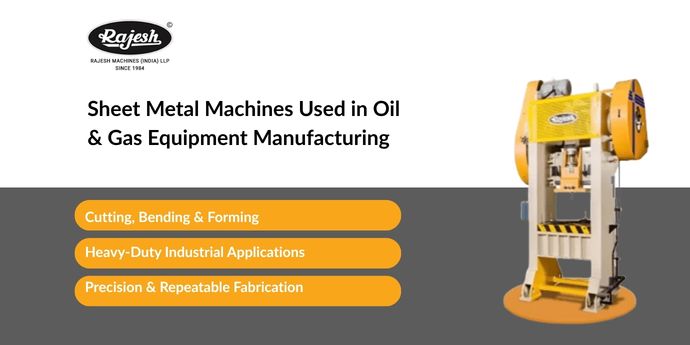
The oil and gas industry requires equipment that handles demanding operating conditions, heavy loads, and strict dimensional requirements. Manufacturing this equipment often involves cutting, bending, punching, forming, and rolling sheet metal into precise components.
The right sheet metal machines help manufacturers produce consistent components while maintaining production efficiency and dimensional accuracy. Commonly used machines include power presses, hydraulic presses, press brakes, shearing machines, and rolling machines.
For manufacturers serving the oil and gas sector in the UAE and other Gulf countries, selecting machinery based on material thickness, component size, production volume, and forming requirements is essential.
Why Sheet Metal Machines Matter in Oil & Gas Manufacturing
Oil and gas equipment manufacturing involves a wide range of metal components. These include enclosures, covers, brackets, supports, tanks, ducting, structural components, and other fabricated parts.
Different manufacturing operations require different machines.
For example:
- Shearing machines cut sheet metal to the required dimensions.
- Press brakes bend sheets into accurate angles.
- Power presses perform punching, blanking, and forming operations.
- Hydraulic presses provide high forming force for heavy-duty applications.
- Rolling machines form curved and cylindrical components.
Using the appropriate machine for each operation helps manufacturers achieve consistent dimensions and repeatable production.
Key Sheet Metal Machines Used in Oil & Gas Equipment Manufacturing
1. Power Press Machines
Rajesh Machines power press machines are used for operations such as punching, blanking, bending, and forming sheet metal components.
In oil and gas equipment manufacturing, power presses are useful for producing repetitive components such as brackets, mounting plates, covers, clips, and other formed parts.
Machine selection depends on factors such as sheet thickness, material type, component geometry, required force, and production volume.
2. Hydraulic Press Machines
Hydraulic presses are designed for applications where controlled and substantial forming force is required. They are suitable for pressing, bending, forming, straightening, and other heavy-duty operations.
Oil and gas equipment often involves thicker materials and larger components than standard sheet metal applications. A hydraulic press provides manufacturers with the force and control needed for such operations.
The required press capacity should be selected according to the material, thickness, component dimensions, and specific forming operation.
3. Press Brake Machines
Press brakes are widely used for accurate sheet metal bending. They form flat sheets into angles, channels, boxes, and other required profiles.
For oil and gas equipment manufacturers, press brakes are useful when producing:
- Equipment enclosures
- Brackets
- Covers
- Support structures
- Panels
- Frames
- Fabricated assemblies
CNC press brakes offer programmable control and repeatability, making them suitable for components requiring consistent bend angles across production batches.
4. Shearing Machines
Shearing machines cut sheet metal into required lengths and widths before further fabrication.
Accurate cutting is an important first step because incorrect blank dimensions affect subsequent bending and forming operations.
Shearing machines are commonly used to prepare material for:
- Press brake operations
- Power press operations
- Rolling
- Fabricated equipment
- Industrial panels and enclosures
Manufacturers should consider sheet thickness, cutting length, material type, and production requirements when selecting a shearing machine.
5. Rolling Machines
Rolling machines form flat metal sheets into curved or cylindrical shapes. They are particularly useful when manufacturing components where a curved profile is required.
Depending on the machine configuration and application, rolling operations are used for components such as:
- Cylindrical sections
- Tanks
- Covers
- Pipes and related fabricated components
- Curved structural parts
Material thickness, rolling diameter, sheet width, and required curvature are important factors when choosing a rolling machine.
Oil & Gas Equipment Manufactured Using Sheet Metal
Sheet metal machinery supports the production of many components used across oil and gas facilities and related industrial applications.
Storage and Process Equipment
Large industrial equipment often requires formed, bent, rolled, or fabricated metal components. Rolling machines and hydraulic presses are useful for operations involving larger or thicker materials.
Pipeline Components
Pipeline-related manufacturing involves components that require accurate cutting, forming, bending, and fabrication. The machinery used depends on the component design, material thickness, and production requirements.
Industrial Enclosures
Electrical and mechanical enclosures require accurate cutting and bending. Shearing machines prepare the blanks, while press brakes form them into the required shapes.
Drilling Equipment Components
Drilling and oilfield equipment contains numerous heavy-duty fabricated and formed components. Hydraulic presses, power presses, and other heavy-duty machinery support different manufacturing operations.
Refinery Equipment Components
Refinery environments require a wide range of fabricated metal components. Manufacturers use cutting, bending, forming, and rolling operations to produce parts according to equipment designs and fabrication requirements.
How to Choose Sheet Metal Machines for Oil & Gas Manufacturing
Choosing machinery should start with the actual manufacturing requirements rather than the machine name alone.
Material Thickness
Determine the maximum and minimum sheet thickness the machine needs to process. Thicker materials generally require greater machine capacity.
Material Type
Steel, stainless steel, aluminium, and other materials have different forming and cutting characteristics. The machine should match the materials used in production.
Component Dimensions
Consider the maximum sheet width, length, component size, and forming geometry. These dimensions directly affect the required machine working area and capacity.
Required Operation
Identify whether the production process requires cutting, punching, bending, pressing, forming, or rolling. Different operations require different machine configurations.
Production Volume
For high-volume production, repeatability, automation, CNC controls, and quick setup become more important. For lower-volume work, flexibility and ease of setup may have greater importance.
Accuracy and Repeatability
Oil and gas equipment components often need consistent dimensions during fabrication and assembly. CNC-controlled machinery helps manufacturers maintain repeatable operations when correctly programmed and set up.
Machine Capacity
Press capacity, bending length, shearing capacity, and rolling capability should correspond to the materials and components being manufactured. Selecting a machine with insufficient capacity can restrict production, while excessive capacity can increase investment without providing a practical benefit.
Benefits of Using the Right Sheet Metal Machinery
The correct combination of machines helps manufacturers build a more controlled fabrication process.
Key benefits include:
- Consistent component dimensions
- Repeatable production
- Better material utilization
- Faster fabrication operations
- Reduced manual processing
- Improved production planning
- Ability to handle different component designs
- Better integration between cutting, forming, and bending operations
However, machine performance also depends on correct tooling, setup, operator skills, maintenance, and material selection.
Sheet Metal Machinery for Oil & Gas Manufacturing in the UAE
The UAE has a strong industrial and energy sector, creating demand for machinery used in metal fabrication and equipment manufacturing.
Manufacturers supplying oil and gas projects need machinery suited to their actual fabrication requirements. The right combination of power presses, hydraulic presses, press brakes, shearing machines, and rolling machines helps manufacturers handle different cutting and forming operations within their production facilities.
When selecting machinery, consider the materials you process, component dimensions, production volume, required accuracy, available floor space, and future production requirements.
Rajesh Machines provides industrial sheet metal machinery designed for a range of cutting, bending, pressing, forming, and rolling applications.
Conclusion
Sheet metal machines play an important role in manufacturing components for the oil and gas industry. Power presses, hydraulic presses, press brakes, shearing machines, and rolling machines each serve different fabrication requirements.
The best machine combination depends on the material, thickness, component geometry, production volume, and required manufacturing operation.
For oil and gas equipment manufacturers in the UAE and Gulf region, evaluating these factors before investing in machinery helps create a more efficient and reliable fabrication setup.
FAQs
Which sheet metal machines are used in oil and gas equipment manufacturing?
Common machines include power presses, hydraulic presses, press brakes, shearing machines, and rolling machines. Each machine performs different cutting, bending, pressing, forming, or rolling operations.
Which machine is used for bending sheet metal for oil and gas equipment?
Press brake machines are commonly used for controlled sheet metal bending. CNC press brakes are suitable for applications requiring repeatable bend angles and dimensions.
What machine is used for heavy-duty sheet metal forming?
Hydraulic presses are commonly used for heavy-duty pressing and forming applications. Required capacity depends on material type, thickness, component dimensions, and forming operation.
How do I choose a sheet metal machine for oil and gas manufacturing?
Consider material type and thickness, component dimensions, required operation, production volume, machine capacity, accuracy requirements, tooling, and future production needs.
Why is machine capacity important in oil and gas equipment manufacturing?
Machine capacity determines whether the equipment can safely and effectively process the required material and component dimensions. Capacity should match the actual production requirements.