
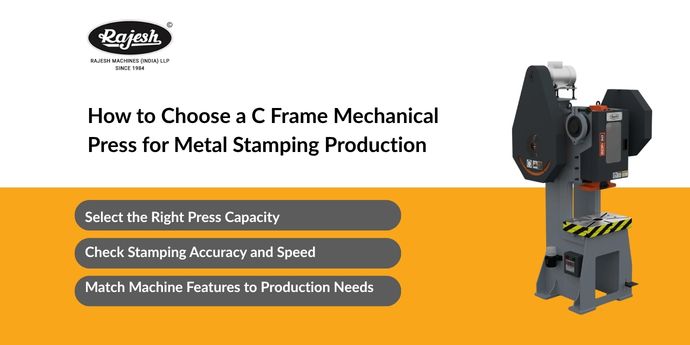
Buying a press is not like buying a pen. Once it is bolted to your floor, it will run your parts for years. If you pick the wrong one, you will feel it every day: missed output, broken dies, rushed repairs.
Most buyers start with one question: “How many tons do I need?” That matters, but it is only one piece. A C frame mechanical press also has to fit your die, run at the right speed, stay safe for your operators, and keep working in a hot, dusty UAE workshop.
This guide walks you through the checks in the order we would do them. You will see what to measure, what to ask your supplier, and where buyers usually go wrong. If you already know the basics of power press machines, you are in the right place. If you want a full machine overview first, read our C-type power press machine guide. This article is about choosing, not defining.
1. Define Your Metal Stamping Production Requirements
Start with your parts, not the machine. Everything else follows from here.
Identify the Components You Need to Produce
Write down every part this press will make. Electrical terminals, brackets, washers, clips, small enclosures, hardware: each one has its own size, shape and operations.
Also note the operations. Will the press blank, pierce, bend, or form? A press that is fine for simple blanking may struggle with deeper forming. If you are not sure how these jobs differ, see our post on the difference between punching and stamping.
Assess Material Type, Thickness, and Part Geometry
Material and thickness decide how much force you need. Mild steel, stainless steel, aluminium and brass all behave differently. Thicker and harder material needs more force. Long cutting edges need more force too.
Check your drawings for the longest cut, the smallest hole, and the tightest tolerance. If you are still deciding on material, our guide on choosing the right sheet metal will help.
Estimate Daily Output and Production Volume
Be honest about volume. A job that runs a few thousand parts a month needs a different press than one that runs thousands per shift.
Think about the next two or three years, not only this month. If you expect orders to grow, tell your supplier now. Buying a press that is just big enough today often means buying again soon.
2. Calculate the Required Press Capacity
Tonnage is the number everyone asks about. Let’s make it simple.
Understand the Factors Affecting Stamping Force
For a cutting operation like blanking or piercing, three things decide the force:
- Cutting perimeter: the total length of the edge being cut
- Material thickness
- Shear strength of the material
The basic idea is: force = cutting perimeter × thickness × shear strength.
Account for Material Strength and Cutting Perimeter
Here is an illustrative example. It uses assumed numbers to show the method. Your real figures must come from your own drawings and material certificates.
Say you blank a 2 mm mild steel bracket, 100 mm × 60 mm, with four 10 mm holes.
- Outer edge: 2 × (100 + 60) = 320 mm
- Four holes: 4 × (π × 10) ≈ 126 mm
- Total cutting perimeter: about 446 mm
- Assumed shear strength of mild steel: about 300 N/mm²
Force ≈ 446 × 2 × 300 ≈ 267,000 N. That is roughly 27 tonnes-force.
Remember, this is the cutting force only. Stripping force, forming operations, and your die design can add to it. So treat the result as a starting point. Your manufacturer will give you the final recommendation, and they will tell you how much margin makes sense for your application. There is no single margin that fits every job.
Verify Available Force at the Working Point
Here is a detail many buyers miss. A mechanical press does not deliver its full rated force at every point in the stroke. Rated tonnage is available near the bottom of the stroke. Higher up, the available force is lower.
So if your job needs force early in the stroke, such as deep forming, ask your supplier how much force the press gives at that exact point. Blanking and piercing happen close to the bottom, which is where a mechanical press is strongest. For more help with sizing, see our step-by-step guide to choosing press capacity.
3. Check Die Compatibility and Working Dimensions
You can have the right tonnage and still not be able to use the press. The die has to fit.
Evaluate Bed and Bolster Dimensions
The bed (or bolster plate) is the surface your die sits on. Your die shoe must fit on it, with room to clamp it down safely.
Measure the die’s length and width. Then compare with the bed size. Leave space for clamps and for scrap to clear. Also check that the die sits where its load is centred, not pushed to one corner.
Check Stroke Length, Shut Height, and Slide Adjustment
These three terms decide whether your die physically works:
- Stroke: how far the slide travels. It must be long enough to let you load and remove the part.
- Shut height: the distance from the bed to the slide when it is at the bottom of its stroke. Your closed die must fit within this space.
- Slide adjustment: how much you can raise or lower the slide to suit different dies.
Always check the die’s closed height against the press’s shut height and its adjustment range. This is the check that saves you from buying a press that cannot take your tooling. A deeper dive into “press stroke and shut height” with your tool room is time well spent.
Consider Die Weight and Mounting Requirements
Heavy dies need a way to lift and position them. Think about cranes, die carts and clamping slots. Ask how the die is held down, and how long a changeover takes. If you change dies often, easy mounting saves real production time.
4. Match Press Speed to Your Production Targets
Understand Strokes per Minute (SPM)
SPM tells you how many times the slide completes a cycle each minute. It sets the ceiling on your output.
Here is a simple illustrative calculation. Suppose you need 12,000 parts in an 8-hour shift. That is 480 minutes, so you need about 25 parts per minute. But no press runs flat out all day. Feeding, die changes, inspection and breaks all take time. If you plan on about 70% effective running time, you need closer to 36 SPM.
That is why you should never pick a press from its top speed alone. Work backwards from your daily target.
Balance Cycle Time, Part Quality, and Tool Life
Faster is not always better. Higher speed can mean more heat and wear in the die, and harder handling for the operator. For parts with tight tolerances or thicker material, a slower, steadier speed can protect your tooling and keep quality consistent.
There is no ideal SPM that suits every job. Choose the speed your part and die can handle comfortably.
Assess Feeding and Material Handling Requirements
How does the material get in? By hand, or with an automatic feeder? Hand feeding limits your speed. For repeat runs, an automatic feed can raise output and also keep operators’ hands away from the die.
If you may add a feeder later, ask now. Whether a press can accept one depends on its controls, the space around it, and the safety setup. It is far easier to plan that at the start than to retrofit.
5. Evaluate Frame Rigidity and Load Distribution
Understand the Effects of Off-Centre Loading
A C frame has an open front. That is great for access: you can load material and move parts easily. But the open shape also means the frame can flex slightly under load, especially when the force is not centred.
This is called off-centre loading. If your die puts the load far to one side, the frame can deflect, and the slide can tilt. Over time that can show up as uneven wear on the die, burrs, or parts that drift out of tolerance. To limit it, centre the die load and ask your supplier about the press’s rigidity for your type of work. Presses with two connecting points handle off-centre loads differently. See our post on single crank vs double crank presses for more.
Determine When a C-Frame Design Is Suitable
A C-frame press is often a strong choice when:
- You need easy access from three sides
- Your parts are small to medium in size
- Your jobs involve blanking, piercing, shallow forming and similar work
- Floor space is limited
- You want a cost-effective machine for repeat production
You can see the range on our C-frame power press page.
Recognize When an H-Frame Configuration May Be More Appropriate
Sometimes a different frame is the honest answer. Consider an H-frame when:
- The work is heavy-duty or needs very high force
- The die is large, or the load will often be off-centre
- You need the highest rigidity for tight tolerances
Our post on why H-frame presses suit heavy-duty applications explains this in detail, and our C-type vs H-type comparison can help you decide. You can also look at our H-frame (pillar) power press.
6. Review Safety Features and Operating Requirements
A press can injure people quickly. Treat safety as a buying criterion, not an extra.
Check Guarding, Interlocks, and Stopping Provisions
Ask your supplier what comes with the machine:
- Guards around the die area
- Interlocks that stop the press when a guard opens
- The clutch and brake arrangement, and how quickly the slide stops
- Emergency stop buttons within easy reach
Consider Operator Access and Die Change Procedures
Think about how a real operator will work. Can they reach the controls comfortably? Is the die area visible? Is there a safe, simple routine for changing dies? Many accidents happen during setup and die changes, not during normal running.
Verify Applicable Safety Standards
Safety rules differ by country and by workplace. Ask your supplier which standards the press is built to, and check what your own site and local authorities require. Do not assume. Get it in writing.
7. Compare Total Ownership Costs Before Buying
The lowest price on the quotation is rarely the lowest cost over five years.
Review Tooling, Installation, and Auxiliary Equipment Costs
Add up everything beyond the machine:
- Dies and tooling
- Foundation, installation and commissioning
- Feeders, straighteners, lubrication equipment and guarding upgrades
- Lifting equipment for dies
Estimate Maintenance, Energy, and Downtime Costs
UAE conditions matter here. Heat, dust and humidity are hard on bearings, lubrication, clutch parts and electrical panels. Ask how the press is lubricated, how easy it is to service, and what routine maintenance it needs in a hot climate.
Then think about downtime. If the press stops, what does an idle day cost you? That number often outweighs a small price difference.
Evaluate Spare Parts and Technical Support
A good press needs good backup. Ask:
- Are common spare parts in stock locally?
- How fast can a technician reach your site?
- What does the warranty cover, and for how long?
- Is training included for your operators and maintenance team?
Rajesh Machines Middle East operates from Sharjah, so support and spares for UAE and GCC customers are close by.
8. Prepare a Technical Checklist Before Requesting a Quote
The more you tell your supplier, the better the recommendation. Gather these before you call:
- Part drawings with dimensions and tolerances
- Material grade and thickness
- Operations needed (blanking, piercing, bending, forming)
- Estimated production volume per shift and per month
- Die details: length, width, closed height, weight
- Feeding method (manual or automatic) and any plan to automate later
- Site details: power supply, floor space, ceiling height, lifting facilities
- Safety requirements that apply at your plant
If you have a sample part or a die already, even better.
Frequently Asked Questions
1. Can one stamping press handle different component designs without replacing the entire tooling setup?
Yes, often. The press itself can run many parts. What changes is the die. Each component usually needs its own die, and you will adjust the shut height and set up the feed for each job. How easily you switch depends on the press’s slide adjustment, bed layout and clamping arrangement. Very different parts may need different tonnage, so check each job against the press.
2. What information should a manufacturer receive to recommend a press for a new component?
Share your part drawings, material grade and thickness, tolerances, the operations required, die dimensions, target output, and details about your site’s power and space. The checklist in section 8 covers it. The more complete your information, the more accurate the recommendation.
3. Should a manufacturer test a new die on the selected press before approving the purchase?
A trial run is a smart idea when it is possible. It lets you check die fit, sample part quality and dimensions before you commit. Whether a trial can happen depends on tooling availability and the scope of the order. Agree on the acceptance criteria in advance: what you will measure, and what counts as a pass.
4. Can an existing stamping press be upgraded for automatic feeding later?
Sometimes. It depends on the press controls, the space around it, the stroke characteristics, and how guarding and safety circuits can be integrated. Ask the manufacturer to assess your press before you buy a feeder. If you know you will automate, say so when you first request a quote.
5. How should a factory evaluate a press supplier if two quotations offer similar specifications?
Look past the price. Compare how clear and complete the documentation is, how openly the supplier shares specifications, what commissioning support is offered, how fast spares and service arrive, what the warranty covers, and whether the supplier can show the proposed configuration working.
6. What should be agreed upon before a new press is accepted at the factory?
Agree in writing on who handles installation, what the commissioning scope is, how operators will be trained, which documents you will receive, how safety features will be verified, and how the trial run will work. Include the acceptance tests and what happens if the press does not pass.
Conclusion
Choosing a C frame mechanical press comes down to matching five things: your parts, your capacity, your tooling, your speed targets and your safety needs. Then check the full cost of owning it, not only the price tag. If you do those checks in order, you avoid most of the mistakes that lead to the wrong press.
And remember, a quick calculation is only a starting point. The best result comes from sharing your real drawings and numbers with a manufacturer who builds these machines.
Discuss your metal stamping requirements with our team. Send us your component drawings, material, die details and daily output, and we will help you shortlist the right press. Contact Rajesh Power Press today, or call our UAE office on +971 56 792 4040.