
Hardware components may be small, but manufacturing them consistently requires the right combination of machinery, tooling and process control. Brackets, hinges, clips, clamps and metal fittings often need to be produced in large quantities with consistent dimensions.
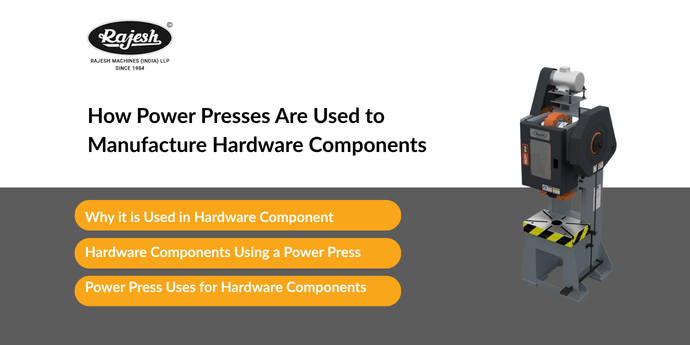
This is where a power press machine for hardware components becomes useful. By using suitable punches and dies, a power press can perform operations such as blanking, punching, bending and forming on sheet metal.
For manufacturers, the right press setup can make repetitive hardware production more consistent and efficient while reducing the amount of manual work involved.
Why Are Power Presses Used in Hardware Component Manufacturing?
Many hardware components are made from sheet metal and require the same shape or hole pattern to be produced repeatedly. Performing these operations manually can take more time and make consistency harder to maintain.
A power press uses a controlled pressing action to perform specific operations with dedicated tooling. Once the punch and die are properly set up, the same operation can be repeated across multiple workpieces.
This makes power presses suitable for manufacturers producing hardware components in medium- and high-volume production environments.
What Hardware Components Can Be Made Using a Power Press?
The exact components that can be produced depend on the material, thickness, design and tooling. Common examples include:
- Hinges
- Brackets
- Clips
- Clamps
- Mounting plates
- Metal fittings
- Washers
- Small covers
- Furniture hardware
- Electrical hardware
- Automotive hardware components
A single component may also require more than one operation. For example, a bracket may first need to be blanked and pierced before being bent into its final shape.
How Does a Power Press Manufacture Hardware Components?
The manufacturing process can vary according to the component design, but a typical production sequence includes several key stages.
1. Sheet Metal Preparation
The process starts with selecting sheet metal that matches the component’s requirements. Material type and thickness are important because they affect the required pressing force and tooling.
The sheet is then prepared in a suitable size or fed into the production setup.
2. Punch and Die Setup
The punch and die are selected according to the required operation and component geometry.
The punch applies force to the material, while the die supports and shapes it. Correct tooling selection and setup are important for achieving the required dimensions.
3. Blanking
Blanking cuts the required component shape from a larger sheet.
For hardware manufacturers producing individual metal parts, this can be an important first step before additional operations are performed.
4. Punching and Piercing
Power presses can also create holes, slots and other openings in sheet metal.
For example, a mounting bracket may require several holes for bolts or fasteners. The punch and die are designed to create these openings at the required locations.
5. Bending and Forming
Some hardware components need to be shaped beyond a flat profile.
Bending changes the angle of the material, while forming can create more specific shapes. These operations allow manufacturers to produce components such as brackets, clips and fittings with their required profiles.
6. Inspection
After pressing, components can be checked for dimensions, hole positions, bends, surface condition and other specified requirements.
Inspection helps identify tooling or process issues before they affect a larger production batch.
Common Power Press Operations for Hardware Components
Different hardware designs require different press operations.
Blanking
Blanking separates the required component profile from the sheet.
Punching
Punching creates holes or openings in the workpiece.
Piercing
Piercing is used to create openings in sheet metal according to the required component design.
Bending
Bending changes the angle or shape of the sheet without completely separating the material.
Forming
Forming creates a specific three-dimensional profile using suitable tooling.
Notching
Notching removes material from an edge or section of the sheet to achieve the required shape.
The appropriate combination depends on the component design and production requirements.
Why Is Tooling Important in Hardware Manufacturing?
The power press provides the force, but the tooling determines how that force is applied to the material.
A punch and die are designed around the required component shape and operation. Their dimensions, clearance and configuration can affect the quality and consistency of the finished part.
Tooling also needs to be matched with the material thickness and type. Poorly matched tooling can lead to issues such as inconsistent dimensions, excessive wear or poor-quality cuts.
For manufacturers producing the same hardware component repeatedly, maintaining and setting up tooling correctly is an important part of production.
Benefits of Using Power Presses for Hardware Components
Power presses can provide several practical advantages for hardware manufacturers.
Consistent production:
Once the machine and tooling are correctly set up, repeated operations can produce components with consistent dimensions.
Faster repetitive production:
Automating repetitive pressing operations can reduce the amount of manual work required for each component.
Multiple operations:
Depending on the machine and tooling, power presses can support blanking, punching, piercing, bending and forming applications.
Suitable for volume production:
Power presses are commonly used where manufacturers need to produce large quantities of similar components.
Better process control:
A controlled machine-and-tooling setup can make repetitive manufacturing easier to manage compared with fully manual production.
Which Power Press Configuration May Suit Hardware Manufacturing?
Different hardware components can require different press configurations depending on material, component size, production volume and tooling requirements.
C-Frame Power Press Machine: Suitable for many general-purpose sheet metal operations such as punching, blanking and forming.
C-Frame Pneumatic Press: Can be considered for applications where pneumatic operation is suitable for the production process.
H-Frame (Pillar) Power Press: Designed for applications requiring a more robust press structure and higher pressing capacity.
H-Frame (Pillar) Pneumatic Press: Provides an H-frame configuration with pneumatic operation for suitable production applications.
Cross-Shaft Precision Press: Can be considered where controlled and repeatable pressing is important for precision components.
Single Crank Double Point Pneumatic Press: Suitable for applications where the component and tooling require a double-point pressing arrangement.
The appropriate configuration depends on the component design, material thickness, required force, tooling and production volume. Manufacturers should evaluate these factors before selecting a machine.
How to Choose a Power Press for Hardware Manufacturing
Not every power press is suitable for every hardware component. Machine selection should begin with the production requirements.
Consider these factors before selecting a machine:
Material and Thickness
Identify the type and thickness of sheet metal that will be processed. These factors influence the required machine capacity and tooling.
Component Size and Design
The dimensions and geometry of the hardware component affect the required working area and tooling arrangement.
Required Pressing Force
The machine should provide sufficient force for the intended operation and material. Choosing capacity based only on the component’s appearance can lead to an unsuitable machine selection.
Production Volume
A manufacturer producing a few hundred components and one producing thousands of components may have different requirements for machine configuration, automation and production speed.
Stroke and Working Area
Stroke requirements and available bed or table space should match the tooling and component dimensions.
Tooling Requirements
Consider the type of punch and die required for blanking, punching, bending or forming. The machine should accommodate the intended tooling setup.
Power Press Machines for Hardware Component Manufacturing
For hardware manufacturers, selecting the machine is only one part of the production decision. The material, component design, tooling and production volume all need to work together.
Rajesh Machines offers power press machines for industrial sheet metal applications, with different machine configurations available for different manufacturing requirements.
If you are planning to manufacture brackets, hinges, clips, fittings or other sheet metal hardware components, the right machine should be selected based on your actual production requirements rather than machine capacity alone.
Conclusion
Manufacturing hardware components at scale requires more than simply cutting metal into shape. The process needs controlled operations, suitable tooling and a machine that matches the material and production requirements.
A power press machine for hardware components can perform essential operations such as blanking, punching, piercing, bending and forming. With the right punch, die and machine configuration, manufacturers can produce repetitive sheet metal components with greater consistency and less manual effort.
For hardware manufacturers in the UAE and Gulf countries, understanding the component design, material, production volume and tooling requirements is the right starting point for selecting a suitable power press.
If you are evaluating a power press for your hardware manufacturing application, contact Rajesh Machines to discuss your production requirements and machine options.