
High-volume sheet metal production requires consistent bending, repeatable results, and efficient machine operation. When manufacturers produce hundreds or thousands of similar components, manual bending methods often make it harder to maintain the same bend angle and dimensions throughout the production run.
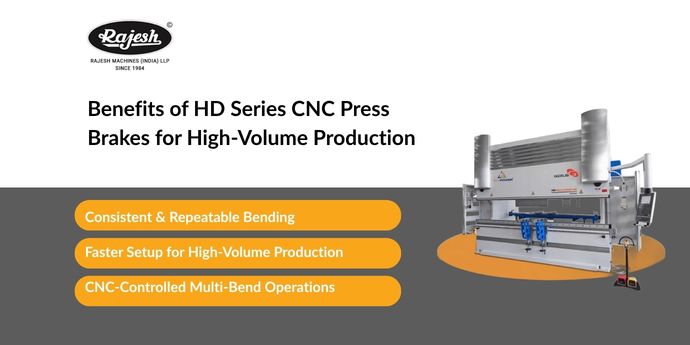
HD Series CNC press brakes are designed for controlled and repeatable sheet metal bending. CNC controls allow operators to program bending parameters, while the machine’s hydraulic system provides the force required for forming sheet metal.
For manufacturers producing electrical panels, enclosures, automotive components, industrial equipment, and other fabricated parts, an HD Series CNC press brake can help create a more consistent and organised bending process.
What Is an HD Series CNC Press Brake?
An HD Series CNC press brake is a CNC-controlled machine used to bend sheet metal into predetermined angles and shapes.
The machine uses a punch and die to form the sheet. CNC controls manage programmed bending parameters, while the press brake applies the required force.
Depending on the machine configuration, operators can control parameters such as:
- Bend angle
- Back gauge position
- Ram movement
- Bending sequence
- Number of bends
- Programmed part dimensions
This makes CNC press brakes particularly useful when the same or similar components need to be produced repeatedly.
Why CNC Press Brakes Are Important for High-Volume Production
High-volume manufacturing places greater emphasis on repeatability and process control.
When operators manually set every bend for every component, variations in setup and positioning can affect production consistency. CNC programming reduces repeated manual adjustments by storing and recalling bending parameters.
For manufacturers producing batches of identical components, this helps create a more controlled production workflow.
Benefits of HD Series CNC Press Brakes for High-Volume Production
1. Consistent Bend Accuracy
One of the main advantages of CNC press brakes is repeatability.
Once the bending program and machine setup are correctly established, the same parameters can be used across multiple components. This helps maintain consistent bend angles and dimensions throughout a production batch.
Consistency becomes particularly important when several bent parts need to fit together during final assembly.
2. Faster Production Setup
High-volume production often involves repeated batches of the same components.
With CNC controls, commonly used programs can be stored and recalled rather than entering all bending parameters from the beginning for every production run.
This helps reduce setup time when repeating established jobs.
3. Reduced Manual Adjustments
CNC control reduces the number of repetitive manual positioning tasks required during production.
The operator still needs to load and position the sheet correctly, monitor the operation, and verify the finished part. However, programmed machine movements reduce the need to manually calculate and adjust every bend.
4. Improved Production Repeatability
Production repeatability is important when manufacturing components in large quantities.
A CNC press brake follows programmed parameters for each bending sequence. When the machine is properly set up and maintained, this provides a consistent process for producing similar components.
This is useful for products such as:
- Electrical panels
- Sheet metal enclosures
- Industrial cabinets
- Automotive components
- HVAC components
- Machine housings
- Brackets and supports
5. Efficient Multi-Bend Operations
Many sheet metal components require several bends.
A CNC press brake can follow a programmed bending sequence, helping the operator complete multiple bends according to the planned process.
The sequence should be designed to minimise handling and avoid interference between the workpiece, tooling, and machine.
6. Better Production Planning
Stored CNC programs help manufacturers organise recurring production jobs.
When a repeat order arrives, the relevant program can be recalled and checked before production begins. This creates a more structured workflow for manufacturers handling regular batches.
Program management also helps reduce dependence on manually recreating bending parameters for every production run.
7. Reduced Material and Labour Waste
Consistent bending helps reduce the number of components rejected because of incorrect bend angles or dimensions.
However, material savings depend on more than the press brake. Accurate blank preparation, suitable tooling, correct programming, and operator inspection all contribute to reducing production waste.
8. Flexible for Different Components
High-volume production does not always mean manufacturing one component continuously.
Manufacturers often produce multiple product variants using different dimensions and bending sequences.
A CNC press brake provides flexibility because different bending programs can be created for different components.
This makes the machine suitable for production environments where manufacturers need both volume and product variety.
HD Series CNC Press Brakes for Different Industries
CNC press brakes support sheet metal bending across a wide range of industries.
Electrical Panel Manufacturing
Electrical panels and enclosures often require multiple precise bends. CNC programming helps maintain consistent dimensions across production batches.
Automotive Components
Automotive suppliers produce brackets, supports, panels, and other sheet metal components in repetitive quantities. Consistent bending helps components meet assembly requirements.
HVAC Manufacturing
Ducting, covers, brackets, and other HVAC components require accurate bends and repeatable dimensions.
Industrial Equipment
Machine housings, guards, frames, and equipment covers often involve several bending operations. CNC press brakes provide a controlled method for producing these components.
General Sheet Metal Fabrication
Fabricators producing different components benefit from programmable bending sequences and repeatable machine operation.
Factors to Consider Before Choosing a CNC Press Brake
The right machine depends on the work being performed. Important factors include:
Bending Length
The required bending length should match the maximum sheet width being processed.
Pressing Force
Required tonnage depends on material type, thickness, bending length, tooling, and bend configuration.
CNC Control
Consider the control system, programming capabilities, storage capacity, and ease of operation.
Back Gauge System
An accurate back gauge helps position the workpiece consistently before bending.
Tooling
Punches and dies should match the material, thickness, bend angle, and component geometry.
Production Volume
High-volume production places greater importance on cycle time, repeatability, program storage, and setup efficiency.
How to Get Better Results from an HD Series CNC Press Brake
Machine capability alone does not guarantee consistent production.
Manufacturers should also focus on:
- Correct tooling selection
- Accurate material preparation
- Proper CNC programming
- Correct back gauge setup
- Regular machine maintenance
- Tool inspection
- Operator training
- First-piece inspection
- Periodic quality checks
A well-maintained machine combined with correct tooling and process control provides a stronger foundation for high-volume production.
HD Series CNC Press Brake vs. Manual Bending
Manual press brake operation can work well for simple jobs and low-volume production. However, high-volume manufacturing requires greater repeatability.
| Factor | HD Series CNC Press Brake | Manual Press Brake |
|---|---|---|
| Programming | CNC programmable | Manual |
| Repeatability | High when correctly set up | More operator-dependent |
| Repetitive production | Well suited | More labour-intensive |
| Bend sequence | Programmable | Manually managed |
| Setup for repeat jobs | Program recall | More manual setup |
| Operator involvement | Required | Higher |
The right choice depends on production volume, component complexity, accuracy requirements, and available investment.
Conclusion
HD Series CNC press brakes offer several advantages for high-volume sheet metal production, including repeatable bending, programmable operation, faster setup for recurring jobs, reduced manual adjustments, and better production consistency.
For manufacturers producing electrical panels, automotive components, HVAC products, industrial equipment, and other fabricated parts, CNC-controlled bending provides a more structured approach to repetitive production.
However, machine selection should always consider bending length, press capacity, material thickness, tooling, CNC capabilities, production volume, and component geometry.
For high-volume manufacturing, the right HD Series CNC press brake can become an important part of a controlled and repeatable sheet metal fabrication process.