
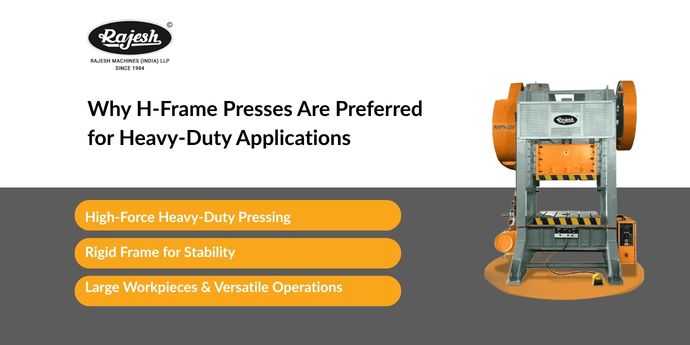
Heavy-duty pressing requires a machine that delivers high force while maintaining stability during demanding forming, straightening, bending, and assembly operations. This is where H-frame presses are widely used.
Also known as pillar presses, H-frame presses feature a rigid frame structure supported by vertical columns. This construction provides a stable working platform for applications involving large components, thick materials, and high pressing forces.
For manufacturers handling heavy-duty metalworking, selecting the right press depends on required force, workpiece size, stroke, working area, production volume, and the type of pressing operation.
What Is an H-Frame Press?
An H-frame press gets its name from the shape of its main frame. Two vertical columns connect the upper and lower sections of the machine, creating a rigid structure around the working area.
The design provides support during pressing operations and helps the machine handle substantial loads.
H-frame presses are commonly used for:
- Heavy-duty forming
- Straightening
- Bending
- Assembly and press fitting
- Component shaping
- Metalworking applications
- Maintenance and repair operations
The exact applications depend on the press configuration, capacity, tooling, and workpiece requirements.
Why Are H-Frame Presses Used for Heavy-Duty Applications?
1. Rigid Frame Construction
Heavy pressing generates substantial forces. A rigid frame helps support these forces during operation.
The H-frame structure distributes the load through its vertical columns and supporting members. This makes the design suitable for applications where stability is important.
For manufacturers working with thick materials or large components, frame rigidity is an important consideration when selecting a press.
2. High Pressing Capacity
H-frame presses are available in different capacities to suit various industrial applications.
Higher-capacity machines are used where significant force is required for operations such as forming, straightening, pressing, and assembly.
However, press capacity should always be selected according to the actual operation rather than assuming a higher tonnage is automatically better.
3. Suitable for Large Workpieces
The open working area of an H-frame press provides flexibility when positioning larger components.
This is particularly useful for fabrication and maintenance applications where the workpiece cannot easily be enclosed within a smaller machine structure.
Manufacturers should consider bed dimensions, working height, throat clearance, and component size before selecting a machine.
4. Versatile Pressing Operations
Lorem ipsum dolor sit amet, consectetur adipiscing elit. Ut elit tellus, luctus nec ullamcorper mattis, pulvinar dapibus leo.
Straightening:
Bent shafts, plates, frames, and other components can be corrected using controlled pressing force.
Bending:
The press can shape metal components according to the required geometry and tooling arrangement.
Forming:
Sheet metal and other metal components can be formed using suitable dies.
Press Fitting:
Controlled force can be applied to install or remove bearings, bushes, pins, and other fitted components.
Assembly:
Certain heavy-duty assembly operations require controlled pressing force to bring components together.
5. Better Accessibility
The H-frame design provides an accessible working area around the component.
This helps operators position larger workpieces and tooling more easily. Accessibility becomes particularly important for maintenance, repair, and low-volume manufacturing applications where components vary in size and shape.
6. Flexibility for Different Tooling
Heavy-duty pressing applications often involve different dies, fixtures, punches, and support arrangements.
H-frame presses provide a practical platform for configuring tooling according to the application.
The tooling must still be correctly rated and aligned with the machine’s capacity and operating requirements.
H-Frame Press Applications
H-frame presses are used across several industrial sectors because of their flexibility and heavy-duty construction.
Automotive Manufacturing
Automotive manufacturers and component suppliers use presses for operations such as straightening, forming, bearing installation, and component assembly.
General Engineering
Engineering workshops use H-frame presses for bending, pressing, straightening, and maintenance work involving different component sizes.
Fabrication
Fabrication operations often involve thick plates, structural components, and formed parts. An H-frame press provides the required working space and pressing force for suitable applications.
Oil & Gas Equipment
Oil and gas equipment manufacturing and maintenance often involve large and heavy components. H-frame presses support selected forming, straightening, assembly, and repair operations.
Agricultural Equipment
Manufacturers and repair workshops use presses for components found in tractors, implements, shafts, frames, and other agricultural machinery.
Industrial Maintenance
Maintenance teams use H-frame presses for removing and installing bearings, straightening components, and carrying out other controlled pressing operations.
H-Frame Press vs. C-Frame Press
H-frame and C-frame presses serve different requirements.
| Feature | H-Frame Press | C-Frame Press |
|---|---|---|
| Frame structure | Rigid four-column-style structure | C-shaped open frame |
| Heavy-duty applications | Highly suitable | Suitable for selected applications |
| Large workpieces | Better suited | More limited |
| Working access | Broad working area | Easy front access |
| Typical applications | Forming, straightening, pressing, assembly | Punching, blanking, bending |
| Load handling | Designed for substantial loads | Depends on machine configuration |
The choice should depend on the required operation, workpiece dimensions, force requirements, and production environment.
How to Choose an H-Frame Press
Selecting an H-frame press requires more than choosing the required tonnage.
Press Capacity
Determine the maximum force required for your applications. Consider material type, thickness, component geometry, and tooling.
Working Area
Check the distance between the columns and the available bed dimensions. The workpiece and tooling need sufficient space for safe positioning.
Stroke Length
The required stroke depends on the application. Forming, straightening, and press-fitting operations often have different stroke requirements.
Working Height
The available height between the bed and ram affects the size of components and tooling that can be accommodated.
Tooling
Evaluate the dies, punches, fixtures, and other tools required for your operations. Their dimensions and load requirements should match the press.
Production Requirements
Consider whether the press will be used for continuous production, occasional fabrication, maintenance, or repair work. This affects the machine configuration and operating requirements.
H-Frame Presses for Heavy-Duty Metalworking
The main reason H-frame presses remain popular in heavy-duty applications is their combination of rigidity, pressing capacity, working space, and versatility.
They provide a practical solution for manufacturers and workshops that need to work with large components or applications requiring substantial pressing force.
However, the machine should always be matched to the intended application. Press capacity, frame design, tooling, material properties, and operating conditions all affect performance.
Conclusion
H-frame presses are preferred for many heavy-duty applications because their rigid frame construction provides stability under substantial pressing loads. Their accessible working area and tooling flexibility also make them suitable for forming, straightening, bending, press fitting, assembly, and maintenance operations.
When choosing an H-frame press, consider press capacity, working area, stroke length, working height, tooling, material characteristics, and production requirements.
For manufacturers and industrial workshops, the right H-frame press provides a flexible platform for demanding pressing applications while supporting consistent and controlled operations.
Frequently Asked Questions
What is an H-frame press used for?
H-frame presses are used for heavy-duty forming, straightening, bending, pressing, assembly, and press-fitting operations.
Why is an H-frame press suitable for heavy-duty work?
Its rigid frame construction provides stability when substantial pressing forces are applied, making it suitable for demanding industrial applications.
What is the difference between an H-frame and C-frame press?
An H-frame press generally provides a more rigid structure and larger working area for heavy-duty applications, while C-frame presses provide convenient front access and are commonly used for punching, blanking, and other lighter or moderate-duty operations.
How do I select the right H-frame press capacity
Consider the material, thickness, component dimensions, forming or pressing operation, tooling, and maximum force required. Select capacity based on the actual application requirements.
Are H-frame presses suitable for large components?
Yes. Their working configuration and accessible press area make them suitable for many applications involving larger components, provided the machine’s dimensions and capacity match the workpiece.