
An electrical enclosure only gets one shot at fitting right. If the door isn’t flush with the gasket, the IP rating on the box doesn’t mean much. If the mounting holes on panel #1 don’t line up the same way as panel #500, someone on the shop floor is hand-fitting hardware on every single unit. And if a bend on a switchgear cabinet is off by even a couple of degrees, it’s not just a look problem — it can throw off the safety clearances around live components.
None of this happens by chance. It happens because a press brake bent the sheet metal to the right angle, the same way, every single time. That’s why the press brake is the machine that matters most in electrical panel and enclosure work — not just another tool on the floor.
Where the Press Brake Fits In
Most electrical parts follow the same basic steps: the sheet gets cut to shape first (by laser or turret punch), then it goes to the press brake to be bent into shape, then it moves on to welding, hardware, and coating. The press brake is the step where a flat piece of metal becomes an actual enclosure — the walls, doors, mounting panels, gland plates, cable trays. Everything after that step depends on the bend being right. Welding and hardware fitting can’t fix a bad bend. They can only work around it, and usually not well.
Why Accuracy Matters More Here Than in Most Sheet Metal Work
Electrical enclosures have to meet standards that a lot of other sheet metal parts don’t:
Compliance ratings depend on it. NEMA, UL, and IP ratings assume the enclosure actually seals the way it’s supposed to. If a door sits slightly out of square, or a panel edge doesn’t sit flush because the bend drifted, the rating doesn’t mean much anymore — even with a good gasket.
Every unit has to match. A panel builder isn’t making one cabinet. They’re making a whole batch that all need to take the same hardware, the same door, the same bracket — without adjusting each one by hand. That only works if every bend across the run lands at the same angle, unit after unit.
Clearances are a safety matter, not just a fit issue. Inside a switchgear or distribution panel, the space between live parts and grounded metal is set to a strict standard. If a bend shifts a mounting panel by even a few millimeters, that safety gap shifts too.
What Actually Makes This Work
Two things on a good press brake do most of the heavy lifting here.
Crowning. When a press brake applies real force across a long bed, the ram and bed bend slightly under the load — they bow a little toward the middle. If nothing compensates for this, you get “canoeing”: the ends of the bend measure correctly, but the middle drifts off by a degree or two. On a long cabinet wall or door, that’s the kind of flaw that leaves a welder fighting the metal with clamps to close the gap. A good crowning system pushes the middle of the bed up just enough to cancel out that bow, so the angle stays true along the whole length of the bend.
Back gauge accuracy. The back gauge positions the sheet for each bend. Its accuracy decides whether a flange lands exactly where the drawing says it should — which matters a lot when that flange has to line up with a mounting hole or another panel. A servo-driven back gauge with tight, repeatable accuracy is what keeps unit #1 and unit #500 exactly the same.
Together, these two things are the difference between an enclosure that goes together with a torque wrench and one that needs a sledgehammer and some luck.
Why CNC Control Helps Panel and Enclosure Work Specifically
Enclosure parts usually need more than one bend — a cabinet wall might need several flanges at different angles, repeated across dozens or hundreds of identical parts. A CNC press brake saves the full bend sequence as a program, so the operator isn’t re-measuring or re-adjusting between parts. That helps in two specific ways:
- Every unit comes out the same, no matter who’s running the machine or which shift made it — important when every part in the batch has to match.
- Switching jobs is faster. Panel builders often run mixed production — LT panels one day, junction boxes the next. A stored program means the operator doesn’t have to reset the machine from scratch for each new part design.
Press Brake vs. Panel Bender: A Fair Note
If a shop is making very high volumes of one or two repeated enclosure shapes, a dedicated panel bending machine can cut down on manual handling even more than a press brake. It’s worth knowing that option exists. But most panel and enclosure shops build a mix — switchgear cabinets, junction boxes, custom brackets, gland plates — rather than one shape at very high volume. For that kind of work, a CNC press brake’s flexibility across different designs is usually the more practical choice, which is why it’s still the standard machine for this kind of fabrication.
What This Looks Like on a Rajesh Press Brake
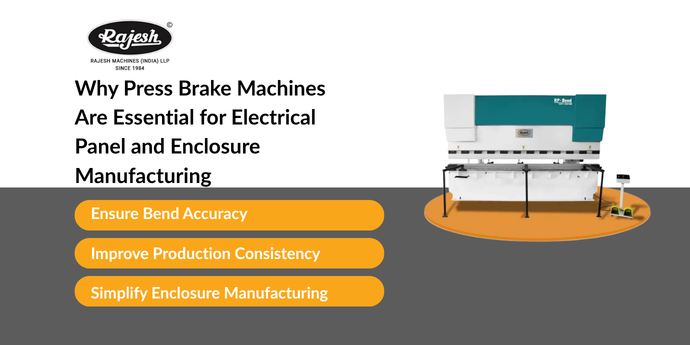
The features that matter most for panel and enclosure work aren’t complicated — they’re the same basics covered above, built into the machine instead of left up to the operator to work around. Rajesh Machines’ Hydraulic NC Press Brake comes with a servo-driven NC back gauge and Taiwan-made ball screws and rods rated to 0.05mm accuracy, plus a manual crowning system and a DSP optical safety guard — the combination that keeps long enclosure panels from canoeing and keeps hole patterns lined up across a full batch. For shops running more complex, multi-bend designs at higher volume, the CNC Press Brake and CNC Press Brake (HD Series) add full CNC crowning control and stored bend programs, so switching between panel designs doesn’t mean setting the machine up from zero each time.
Conclusion
An electrical enclosure is only as good as the bend that shaped it. Compliance ratings, matching parts across a production run, and the safety clearances inside a panel all come back to one thing: whether the press brake held its angle, every time. That comes down to crowning, back gauge accuracy, and reliable control — not just how much force the machine can apply. For any shop building panels, cabinets, or enclosures at real volume, that’s not a nice extra. It’s the whole job.
FAQ
Why does bend accuracy matter more for electrical enclosures than other sheet metal parts?
Electrical enclosures have to meet standards like NEMA, UL, and IP ratings, which depend on doors and panels sealing correctly. They also have internal safety clearances that a bad bend can throw off.
What is canoeing, and why does it matter for cabinet doors and panels?
Canoeing is when a long bend is correct at the ends but drifts off-angle in the middle, because the press brake frame flexes slightly under load. On a long panel or door, this shows up as a part that won’t sit flush. A good crowning system fixes it.
Do I need a CNC press brake, or is an NC machine enough?
It depends on how complex your parts are and how much you’re making. An NC press brake with a servo back gauge handles straightforward panel and cabinet work well. A full CNC machine helps more once you’re running complex multi-bend parts or switching often between different designs.
Is a panel bending machine better than a press brake for enclosures?
If you’re making very high volumes of just one or two repeated shapes, a panel bender can cut down on manual handling even further. Most panel and enclosure shops build a mix of designs, though, so a press brake’s flexibility usually wins out.
What tolerance can I expect from a good NC press brake for panel work?
A quality servo-driven back gauge with Taiwan-made ball screws can hold around 0.05mm positioning accuracy — tight enough to keep hole patterns and flange positions consistent across a full batch.