
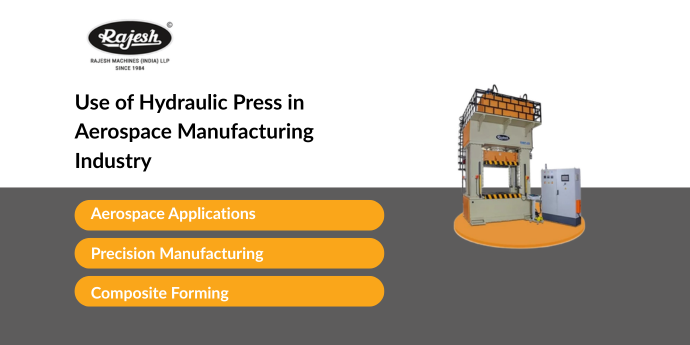
Use of Hydraulic Press in Aerospace Manufacturing Industry
A lot of industrial machines can shape metal without much trouble. Things get much harder once aerospace materials enter the picture.
The materials used in aircraft manufacturing are lighter, stronger, and far less forgiving during forming operations. Titanium resists shaping. Composite materials react badly to inconsistent pressure. Even aluminium panels can lose dimensional accuracy if the forming process is slightly off.
That’s exactly where hydraulic systems started becoming the preferred option.
Aircraft manufacturers don’t just need force. They need consistency. Pressure has to remain stable across long production runs because small forming errors in aerospace work rarely stay small for long.
And fixing those problems later is rarely cheap.
.
Aerospace Materials Are Strong — and Difficult to Form
Aircraft manufacturers constantly try to reduce weight without sacrificing structural strength. The problem is that lightweight aerospace materials are usually more difficult to shape than ordinary industrial metals.
Some of the most common aerospace materials include:
- Titanium alloys
- Aluminium aerospace grades
- Nickel-based superalloys
- Carbon fibre composites
Each material creates different manufacturing challenges.
Titanium is probably the material most fabrication teams complain about. It performs extremely well inside aircraft structures, but it can be frustrating during forming operations if the process is not controlled properly.
Push too hard and cracking becomes a risk. Push too quickly and dimensional accuracy can suffer after the pressure is released.
Composite materials create another set of problems altogether.
Pressure needs to remain controlled during moulding because internal defects are not always visible immediately after production. A component can look completely fine on the outside while still having structural issues internally.
Anyone working in aerospace fabrication has seen situations like this before.
This is where hydraulic press machines make a real difference. Operators get far more control over how force is applied throughout the forming process.
Other industries can sometimes tolerate minor forming variation. Aerospace usually can’t.
Why Aerospace Manufacturers Prefer Hydraulic Presses
Mechanical presses still have an important role in industrial production. They are fast, efficient, and ideal for repetitive high-speed stamping operations.
Aerospace plants generally care more about repeatability than raw output speed.
That changes the machine requirements quite a bit.
Many aerospace forming operations require:
- Adjustable pressure
- Controlled ram movement
- Slower forming speeds
- Better handling of difficult materials
- Pressure holding during forming
Hydraulic presses handle these situations much better because the force can be controlled throughout the operation instead of being delivered in one fast impact movement.
Requirement | Hydraulic Press | Mechanical Press |
Adjustable pressure control | Yes | Limited |
Pressure holding capability | Yes | No |
Better for titanium forming | Yes | Limited |
Composite moulding support | Yes | No |
Smoother forming operation | Yes | Limited |
Nobody wants to scrap an expensive aerospace component because the forming process was too aggressive.
That becomes expensive very quickly once titanium or composite materials are involved.
Understanding the difference between hydraulic and mechanical presses matters when production accuracy becomes more important than maximum speed.
Forming Large Aircraft Panels Accurately
Aircraft fuselage panels are large curved structures that need to fit precisely during final assembly.
Even small dimensional inconsistencies can create alignment problems later in production. That sounds manageable until production volumes increase and rework starts affecting delivery schedules.
Four pillar hydraulic presses are commonly used for these applications because they distribute pressure evenly across large working areas.
These systems are often used for:
- Aircraft skin panels
- Curved aluminium sections
- Structural aerospace panels
- Precision sheet forming operations
Aerospace manufacturers care heavily about repeatability. One incorrectly formed panel can affect far more than a single workstation on the shop floor.
.
Why Titanium Creates So Many Manufacturing Problems
Most fabrication teams already know titanium can be difficult during forming operations.
It’s one of the best aerospace materials available from a performance standpoint. Strong, lightweight, corrosion-resistant, and reliable at high temperatures.
But forming it properly takes patience.
Titanium reacts differently from ordinary industrial metals during shaping operations. If the forming process becomes too aggressive, the material can crack or spring back after pressure is removed.
That’s usually where lower-quality machines start struggling.
Hydraulic systems help manufacturers:
- Apply pressure gradually
- Improve forming consistency
- Reduce tooling stress
- Maintain better dimensional accuracy
For larger aerospace applications, H-frame hydraulic presses are commonly used because they handle high forming loads more effectively.
Aerospace manufacturers care a lot about getting the same result repeatedly across long production runs.
.
Why Composite Manufacturing Depends on Pressure Control
Modern aircraft contain far more composite material than older aircraft designs did.
Carbon fibre components help reduce aircraft weight and improve fuel efficiency, but manufacturing these parts properly requires careful pressure management.
Too much pressure can damage the material structure. Too little pressure can leave internal voids or weak areas inside the component.
And those issues are rarely cheap to fix later.
Hydraulic presses are widely used for:
- Carbon fibre moulding
- Composite panel production
- Resin transfer moulding
- Aerospace interior components
One reason manufacturers prefer hydraulic systems is because pressure remains stable during the entire moulding and curing cycle.
Hydraulic press systems are especially useful in applications where consistency matters more than pure production speed.
Landing Gear and Structural Forging Applications
Landing gear components deal with enormous impact loads throughout an aircraft’s operating life.
Because of that, aerospace manufacturers need forming processes that produce strong and reliable structural components consistently.
Large hydraulic forging presses are commonly used for:
- Landing gear parts
- Aerospace brackets
- Structural supports
- Heavy-duty aircraft fittings
Operators get more time to manage how the material behaves during forming, which makes the process easier to control.
That matters a lot in aerospace manufacturing where structural reliability is critical.
Aerospace Manufacturing Requires Heavy Documentation
One thing many people underestimate about aerospace production is how much documentation is involved.
Manufacturers don’t just need good-looking parts. They also need proof that every production condition stayed within specification throughout the forming cycle.
That includes recording:
- Pressure levels
- Cycle times
- Temperature conditions
- Ram movement
- Production data
Modern hydraulic presses often include PLC systems and digital monitoring tools that automatically track this information.
If a problem appears later, manufacturers can review the production records and trace exactly what happened during the forming operation.
At this point, detailed production tracking is simply part of doing aerospace work.
Understanding hydraulic press system components also matters because long-term pressure stability directly affects forming accuracy over time.
Choosing the Right Hydraulic Press for Aerospace Work
Aerospace manufacturers usually look beyond simple tonnage ratings when selecting machinery.
Most aerospace buyers worry less about maximum tonnage and more about whether the machine can repeat the same result reliably every day.
Important considerations include:
- Pressure accuracy
- Frame stability
- Platen alignment
- Automation capability
- Digital monitoring systems
- Material compatibility
Different press designs fit different applications.
For example:
- C-frame presses allow easier operator access
- Four-pillar presses provide better stability for large panels
- H-frame presses work well for heavy-duty forming operations
Different types of press machines are designed for different production requirements depending on the application.
Aerospace Manufacturing Growth in the UAE
The aerospace sector across the UAE and GCC region has grown steadily over recent years.
Manufacturers involved in aerospace production, MRO services, and precision engineering continue investing in advanced forming equipment and automation systems.
For companies entering aerospace-related manufacturing, machinery quality becomes extremely important because aerospace production leaves very little room for inconsistent process control.
Modern metalworking machinery helps manufacturers improve production consistency, precision, and operational reliability across demanding industrial applications.
Smart Hydraulic Press Systems Are Becoming More Common
Hydraulic press technology has changed significantly in recent years.
Modern aerospace facilities increasingly use smarter systems that combine hydraulic performance with automation and digital monitoring.
Many newer systems include:
- PLC automation
- IoT monitoring
- Predictive maintenance tools
- Real-time pressure tracking
- Production data logging
Most companies moving toward smarter press systems are mainly trying to avoid production interruptions and quality problems that become expensive later.
Modern hydraulic press technology continues evolving alongside automation and smart manufacturing systems.
FAQs
Why are hydraulic presses used in aerospace manufacturing?
Hydraulic presses give manufacturers better control over forming pressure, which is important when working with aerospace materials such as titanium alloys, aluminium panels, and composite structures.
What materials are commonly formed using hydraulic presses in aerospace?
Common aerospace materials include:
- Titanium alloys
- Aluminium alloys
- Nickel-based superalloys
- Carbon fibre composites
These materials require controlled forming conditions during production.
Are hydraulic presses suitable for composite moulding?
Yes. Composite manufacturing depends heavily on pressure consistency, which is one reason hydraulic presses are commonly used for carbon fibre moulding operations.
Which hydraulic press design is commonly used in aerospace manufacturing?
Different aerospace applications use different press designs:
- Four-pillar presses for large panel forming
- H-frame presses for heavy-duty operations
- C-frame presses for smaller precision work
Are CNC press brakes also used in aerospace manufacturing?
Yes. CNC hydraulic press brakes are commonly used for precision bending of aerospace sheet metal components and structural parts.
Final Thoughts
Aerospace manufacturing depends heavily on precision, repeatability, and controlled forming conditions.
That’s exactly why hydraulic press systems continue playing such an important role across the industry.
From titanium forming to composite moulding and structural component production, hydraulic presses help manufacturers maintain the level of control modern aerospace production demands.
Explore the hydraulic press range for industrial applications, including H-frame, C-frame, and four-pillar hydraulic presses.
Talk to Us About Your Hydraulic Press Requirements
Rajesh Power Press supplies hydraulic press machines for industrial manufacturing applications across the UAE and GCC region.
Whether the requirement is precision forming, heavy-duty production, or customised hydraulic press solutions, our team can help you choose equipment that fits your manufacturing needs.
Contact us or browse the full hydraulic press range for more information.