
Sheet Bending vs. Metal Forming: Key Differences Explained
Walk into almost any fabrication workshop and you’ll hear both terms used regularly — sheet bending and metal forming. Sometimes people use them interchangeably. That’s where the confusion usually starts.
Technically speaking, bending is part of metal forming. But inside a real manufacturing environment, the two processes solve very different production problems.
And choosing the wrong process can create issues surprisingly quickly.
The machine requirements change. Tooling changes. Production costs change. Even the way the material behaves changes depending on whether the operation is bending or full metal forming.
That’s why understanding the difference matters more than many people realise.
What Is Sheet Bending?
Sheet bending is one of the most common operations in metal fabrication.
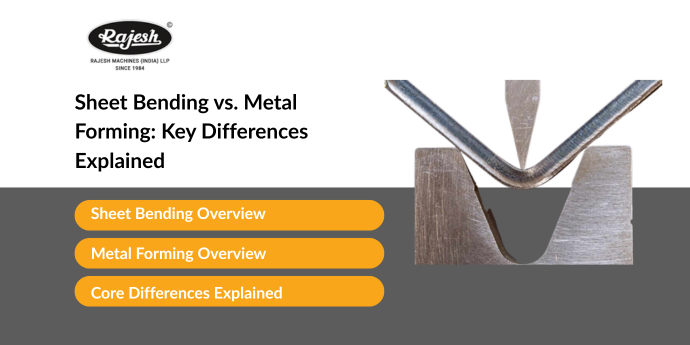
The process is fairly simple in concept. A flat metal sheet is bent along a straight line to create an angle or shape without cutting the material.
The important thing is this:
- the sheet stays mostly flat,
- the material does not completely change shape,
- and deformation mainly happens around the bend line itself.
Most workshops use a press brake for this type of work.
A punch presses the sheet into a die, creating the required angle. Operators can produce:
- 90-degree bends,
- channels,
- brackets,
- enclosures,
- cabinet panels,
- and structural sections.
If you look around most fabrication shops, a huge percentage of sheet metal components were made using bending operations.
That’s because bending is:
- fast,
- repeatable,
- relatively economical,
- and ideal for angular parts.
Common Sheet Bending Methods
Different bending methods are used depending on the material, accuracy requirement, and production volume.
Air Bending
Air bending is the most widely used process today.
The punch does not fully force the sheet into the die. Instead, the bend angle depends on how far the punch travels downward.
Most modern CNC hydraulic press brakes use air bending because it gives shops more flexibility across different jobs.
One tooling setup can often produce multiple bend angles, which saves time during production.
Bottom Bending
Bottom bending pushes the sheet firmly into the die cavity.
This method produces:
- better angle consistency,
- less spring-back,
- and improved repeatability.
The trade-off is that it usually requires:
- higher tonnage,
- more force,
- and dedicated tooling for different bend angles.
Coining
Coining uses extremely high pressure to compress the material at the bend area.
It produces very accurate bend angles with minimal spring-back, but the tonnage requirement becomes much higher.
Most general fabrication shops avoid coining unless precision requirements justify the extra force and tooling stress.
What Is Metal Forming?
Metal forming is a much broader manufacturing category.
Instead of simply creating bends or angles, forming changes the overall shape of the material more dramatically.
The metal may:
- stretch,
- compress,
- flow,
- or move into complex three-dimensional shapes.
This is where things start becoming very different from ordinary bending operations.
Metal forming includes processes such as:
- deep drawing,
- stamping,
- forging,
- compression forming,
- roll forming,
- and stretch forming.
A simple bracket with two bends is a bending job.
A car body panel with complex curves is a forming job.
A stainless steel kitchen sink drawn from flat sheet into a basin shape is also forming.
The difference becomes obvious once the material starts moving in multiple directions instead of rotating around a single bend line.
The Real Difference Between Bending and Forming
This is the easiest way to understand it.
In Sheet Bending:
- deformation happens mainly at the bend line,
- flat sections stay mostly unchanged,
- and the part geometry remains angular.
In Metal Forming:
- material movement happens across larger areas,
- thickness may change,
- and the final shape becomes more three-dimensional.
That changes everything from tooling design to machine selection.
A press brake works extremely well for angular fabrication work.
But if the part needs:
- deep contours,
- drawn sections,
- curved surfaces,
- or complex geometry,
then a standard bending setup is no longer enough.
That’s usually where hydraulic press machines enter the picture.
.
Why Hydraulic Presses Are Common in Metal Forming
Forming operations usually need more control over pressure and material movement.
Hydraulic presses work well because operators can:
- apply pressure gradually,
- control ram speed,
- hold pressure when needed,
- and manage material flow more carefully.
That level of control matters a lot during:
- deep drawing,
- stamping,
- compression moulding,
- and heavy forming operations.
Some materials become difficult very quickly if pressure is applied too aggressively.
Anyone working in production has seen situations where poor forming control caused:
- tearing,
- wrinkling,
- dimensional inconsistency,
- or tooling damage.
That’s one reason hydraulic systems remain heavily used across industrial forming applications.
Machines Used for Sheet Bending
Press Brakes
The press brake is the primary bending machine in most fabrication shops.
Modern press brakes include:
- CNC controls,
- back-gauge automation,
- angle correction systems,
- and crowning compensation.
These features help manufacturers improve consistency across long production runs.
Hydraulic press brakes are especially common because they provide smoother force control during bending operations.
Plate Rolling Machines
For curved bending work, rolling machines are commonly used.
A hydraulic rolling machine gradually bends sheet or plate into cylindrical or conical shapes.
These systems are widely used for:
- tanks,
- pipes,
- pressure vessels,
- and structural rolling applications.
Machines Used for Metal Forming
Hydraulic Presses
Hydraulic presses handle many heavy-duty forming applications.
Different configurations suit different jobs:
- C-frame hydraulic presses for smaller precision work
- H-frame hydraulic presses for heavier forming operations
- Four pillar hydraulic presses for large-area forming and compression work
The ability to apply controlled force throughout the stroke makes hydraulic systems highly adaptable.
Power Press Machines
C-frame power presses are commonly used for high-speed stamping and repetitive production work.
These machines are ideal when:
- production volume is high,
- part geometry remains consistent,
- and speed becomes more important than adjustable force control.
Mechanical presses usually run faster than hydraulic systems, but they offer less flexibility during complex forming operations.
When Sheet Bending Makes More Sense
Sheet bending is usually the better option when:
- the part contains straight bends,
- flat sections dominate the design,
- tooling budgets are lower,
- or production flexibility matters.
Common bending applications include:
- electrical cabinets,
- brackets,
- machine covers,
- steel frames,
- shelving,
- and industrial enclosures.
Bending also works well for lower-volume custom fabrication because tooling costs stay relatively manageable.
That’s one reason press brakes are so widely used across fabrication shops of all sizes.
When Metal Forming Becomes Necessary
Forming becomes necessary when the component geometry is more complex.
Typical forming applications include:
- automotive body panels,
- aerospace components,
- deep drawn housings,
- kitchen sinks,
- pressure vessel components,
- and structural stampings.
These parts often require material to move in multiple directions simultaneously.
And once that happens, ordinary bending operations usually stop being practical.
Forming dies are typically more expensive than bending tooling, which is why forming processes become more economical at larger production volumes.
Cost and Production Differences
Factor | Sheet Bending | Metal Forming |
Tooling Cost | Lower | Higher |
Setup Time | Faster | Longer |
Production Flexibility | High | Moderate |
Part Geometry | Angular | Complex 3D Shapes |
Machine Type | Press Brake | Hydraulic Press / Power Press |
Material Movement | Localised | Large Area Material Flow |
Best for Small Batches | Yes | Sometimes |
Best for High-Volume Production | Moderate | Excellent |
Neither process is universally better.
The right choice depends entirely on:
- the part design,
- production volume,
- material type,
- and manufacturing goals.
Press Brake vs Hydraulic Press
This comparison confuses a lot of buyers.
A press brake is mainly designed for bending operations.
A hydraulic press is designed for forming, pressing, stamping, drawing, compression work, and several other applications.
Some overlap exists, but the machines are built for different production requirements.
If the work mainly involves:
- angular bends,
- sheet folding,
- and enclosure fabrication,
a press brake usually makes more sense.
If the work involves:
- deep drawing,
- forming,
- stamping,
- or large compression loads,
a hydraulic press becomes the better option.
Understanding different types of press machines helps manufacturers avoid expensive equipment mistakes later.
Where Bending and Forming Often Overlap
Many industrial components actually use both processes together.
For example:
- a formed panel may later require edge bending,
- a stamped part may need secondary flange bends,
- or a drawn enclosure may still need finishing operations on a press brake.
Real production environments rarely stay limited to one single process.
That’s why manufacturers often operate:
- press brakes,
- hydraulic presses,
- and power presses together within the same facility.
Understanding how these processes connect helps production planning become much more efficient.
FAQs
Is sheet bending the same as metal forming?
Not exactly. Bending is technically one type of forming, but in manufacturing discussions they usually describe different operations. Bending mainly creates angles, while forming creates more complex three-dimensional shapes.
Which machine is commonly used for sheet bending?
Press brakes are the most common machines used for sheet bending operations. CNC hydraulic press brakes are especially popular in modern fabrication environments.
Which machine is used for metal forming?
Hydraulic presses and power presses are widely used for metal forming applications such as stamping, deep drawing, and compression forming.
Why are hydraulic presses preferred for forming?
Hydraulic systems allow better pressure control, smoother force application, and improved handling of difficult materials during forming operations.
Is bending cheaper than forming?
In many cases, yes. Bending generally requires simpler tooling and lower setup costs. Forming operations usually involve more complex dies and higher production investment.
Can one component use both bending and forming?
Yes. Many industrial parts combine multiple manufacturing processes during production, especially in automotive, aerospace, and heavy fabrication industries.
Final Thoughts
Sheet bending and metal forming are closely related, but they solve different manufacturing challenges.
Bending focuses on creating angular parts efficiently.
Forming handles more complex shapes where material movement becomes much greater.
Understanding that difference helps manufacturers:
- choose the right machinery,
- improve production planning,
- reduce tooling mistakes,
- and avoid unnecessary manufacturing costs.
If the production requirement is mostly angular fabrication, a press brake is usually the right choice.
If the job involves complex shaping, stamping, or deep drawing, hydraulic forming equipment becomes much more important.
Talk to Us About Your Sheet Metal Processing Requirements
Rajesh Power Press supplies press brakes, hydraulic presses, power presses, and metal fabrication machinery across the UAE and GCC region.
Whether your requirement involves sheet bending, metal forming, or a combination of both, our team can help you choose equipment suited to your production needs.
Contact us or browse the press brake range and hydraulic press range for more information.