
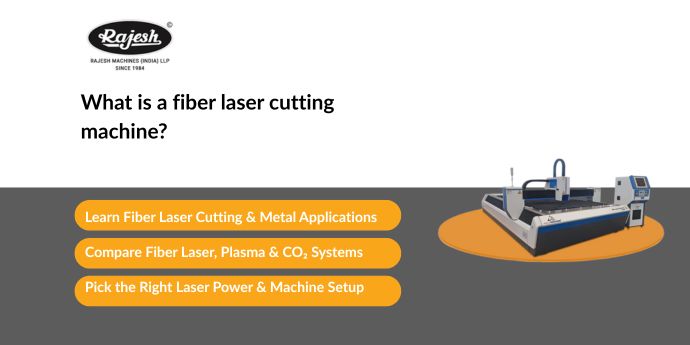
What Is a Fiber Laser Cutting Machine?
A fiber laser cutting machine is an industrial CNC machine that uses a laser beam — delivered through a flexible optical fiber cable — to cut sheet metal and other materials with high precision. Think of it as a very focused, very powerful beam of light that melts metal exactly where you want it, while an assist gas blows the molten material away.
It’s not the same as a CO₂ laser. Not even close. The core difference is where the laser is generated. In a CO₂ machine, the beam is produced inside a gas-filled tube and then bounced to the cutting head using mirrors — which need regular alignment and replacement. With a fiber laser, the beam is generated inside a doped optical fiber (usually ytterbium-doped), and delivered directly through the fiber cable to the cutting head. No mirrors in the beam path. No alignment headaches. Just clean, consistent, powerful light.
That difference, seemingly small, is why factories across the UAE and globally are switching to fiber laser technology. The machine is simply more reliable, more energy-efficient, and more capable on metals — especially reflective ones like copper and brass that CO₂ machines genuinely struggle with.
The term “fiber laser cutter” and “CNC fiber laser machine” are often used interchangeably. Some people also call it a metal laser cutting machine — which makes sense since metals are where fiber lasers truly excel. You can explore the full range of Rajesh fiber laser cutting machines here.
How Does a Fiber Laser Cutting Machine Work?
Here’s the basic flow — and it’s worth understanding because it explains why the machine performs the way it does.
Step 1 — Laser Generation: Laser diodes produce light (called “pump light”). This light is fed into a fiber optic cable whose core is doped with ytterbium, a rare-earth element. The doped fiber amplifies the light into a powerful, coherent laser beam. This happens entirely inside the fiber — no external gas, no external mirrors needed.
Step 2 — Beam Delivery: The amplified beam travels through the fiber cable to the cutting head. Because the fiber itself acts as a waveguide, the beam stays incredibly focused and consistent along its entire path. This is a big deal — CO₂ systems lose beam quality over distance because of their mirror-based delivery. Fiber doesn’t have that problem.
Step 3 — Focusing and Cutting: Inside the cutting head, a high-quality lens focuses the beam to a very fine point on the material surface. The energy density at that focal point is enormous — enough to melt metal almost instantaneously. A nozzle simultaneously blows assist gas (nitrogen, oxygen, or compressed air depending on the material) to eject molten material from the cut zone.
Step 4 — CNC Motion Control: Servo motors move the cutting head (or in some setups, the workpiece) according to the CAD file loaded into the CNC controller. Modern machines can achieve positioning accuracy down to ±0.03mm. The precision of the cut is largely a function of how precisely the servo system can move — and on good machines, that’s very precise indeed.
Step 5 — Cooling: The laser source and optical components generate significant heat. A water chiller keeps everything within operating temperature, protecting both the laser source and the focusing optics. This is one of those maintenance tasks you genuinely can’t skip.
The whole process — from CNC file to finished cut — can happen in seconds for thin sheets, making it dramatically faster than most mechanical or plasma alternatives for sheet metal work. Learn more about how Rajesh fiber laser machines are configured for UAE production environments.
Key Components of a Fiber Laser Cutting Machine
Component | Function |
|---|---|
Fiber Laser Source | The power core — generates the laser beam via doped optical fiber and laser diodes. Rated in watts (1kW to 30kW+ for industrial machines). |
Cutting Head | Houses the focusing lens, nozzle, and focus-tracking system. Directs and focuses the beam onto the workpiece. |
CNC Controller | The brain — reads CAD/CAM files (DXF, DWG, G-code) and coordinates all machine movements. |
Servo Motors | Drive the X, Y, and Z axes with precision. Cutting accuracy is heavily dependent on servo quality. |
Worktable / Bed | Supports the material. Many industrial machines use dual-table systems for uninterrupted production. |
Water Chiller | Keeps laser source and optics at safe operating temperature. Essential for 24/7 production runs. |
Assist Gas System | Delivers oxygen, nitrogen, or compressed air to eject molten material and protect the lens. |
Enclosure / Safety Cabinet | Class 1 safety-interlocked enclosure to contain laser emissions during operation. |
One thing worth knowing: the dual-table setup (where one table is inside the machine cutting while the other is being loaded/unloaded outside) is a feature that makes a real difference in high-volume production. It’s not a gimmick. It cuts operator wait time significantly and keeps the machine actually cutting rather than sitting idle during loading.
What Materials Can a Fiber Laser Cutting Machine Cut?
This is where fiber laser technology really separates itself. Fiber lasers operate at a wavelength of around 1,064nm — much shorter than CO₂ lasers (10,600nm). That shorter wavelength is absorbed much more efficiently by metals, especially reflective ones.
Metals it handles exceptionally well:
- Carbon steel / mild steel — the bread and butter. Fast, clean cuts across a wide thickness range.
- Stainless steel — used heavily in food processing, pharma, and architectural applications. Fiber laser delivers smooth, clean edges.
- Aluminum — notoriously reflective. CO₂ lasers struggle here; fiber lasers handle it without issue.
- Brass — excellent results, commonly used in electrical and decorative applications.
- Copper — another highly reflective metal that fiber lasers handle well. Critical for electrical component manufacturing.
- Titanium — aerospace-grade cutting with the right assist gas settings.
- Galvanized steel — used in HVAC, roofing, and construction.
What it doesn’t cut well: Non-metals like wood, acrylic, leather, or fabric. For those, a CO₂ laser is the right tool — that’s a different thing entirely. Fiber lasers are optimized for metal. If your shop works primarily in non-metal materials, fiber laser is probably not your machine.
Thickness range: With a 1kW source, you can reliably cut up to ~6mm mild steel. A 3kW handles up to ~16mm. Industrial machines at 6kW and above push into 20–25mm territory for mild steel. Aluminum and stainless tend to top out sooner at the same power level.
Advantages of Fiber Laser Cutting — What Actually Matters
There’s no shortage of articles listing the same five benefits of fiber laser cutting. Here’s what those benefits actually mean in a real production environment:
1. Precision That Eliminates Secondary Processing
Fiber laser cutting achieves accuracy in the range of ±0.03–0.05mm with minimal kerf width. That’s not marketing language — it means parts come off the table fitting together correctly, without needing grinding, filing, or rework. For industries like automotive component manufacturing or electrical panel work, this directly reduces labor cost per part.
2. Speed That Changes Production Economics
On thin-to-medium sheet metal (up to 6mm), fiber lasers are dramatically faster than plasma or mechanical methods. We’re talking cutting speeds upward of 40–70 m/min on thin stainless. The machine finishes a job in the time it takes a plasma setup to warm up. That translates directly to higher output per shift.
3. Lower Running Costs Than You'd Expect
Fiber laser machines consume roughly 30–40% less electricity than equivalent CO₂ systems. The solid-state design means no laser gas to refill, no mirrors to replace, and fewer consumables overall. The main ongoing cost is the focusing lens and nozzle — inexpensive, easy-to-source items. Maintenance on a well-run fiber laser is genuinely low. An expensive lesson many shops learn too late is buying a cheaper plasma setup and then spending more on consumables and downtime over three years than the cost difference.
4. Handles Reflective Metals Without Issues
This one gets glossed over too often. Copper, brass, and aluminum are notoriously problematic for CO₂ lasers because their reflectivity can damage the system. Fiber lasers are designed for this — the shorter wavelength is better absorbed by these metals, meaning you can cut copper bus bars or brass fittings without drama.
5. Low Maintenance, High Uptime
No mirror alignment. No laser gas management. The fiber laser source itself typically has a rated lifespan of 100,000+ hours. For a production facility where downtime is money, this is not a minor point. The machine is ready to run when you switch it on, not after a 20-minute warmup and calibration routine.
6. Small Heat-Affected Zone (HAZ)
Because the laser removes material very precisely with a narrow beam, the area around the cut is barely affected thermally. This means less warping, less metallurgical change at the edges, and better part quality — especially important for precision components that go into assemblies.
Fiber Laser vs. Plasma vs. CO₂ — Honest Comparison
Most content on this topic is vague. Here’s a direct comparison that actually helps you decide:
Factor | Fiber Laser | Plasma | CO₂ Laser |
|---|---|---|---|
Cut precision | Excellent (±0.03–0.05mm) | Moderate (±0.5–1mm) | Good (±0.1–0.2mm) |
Cutting speed (thin sheet) | Very fast | Moderate | Fast but slower than fiber |
Thick plate (>20mm) | Possible at high power | Best option here | Not ideal |
Reflective metals (Cu, Al, Brass) | Excellent | Good | Problematic |
Operating cost | Low | High (consumables) | Medium-high |
Maintenance complexity | Low | Medium | High (mirrors, alignment) |
Initial investment | Higher | Lower | Medium-high |
Non-metal cutting | No | No | Yes (wood, acrylic, etc.) |
Energy efficiency | Best | Poor | Moderate |
Edge quality | Excellent (often no post-processing) | Requires cleanup | Good |
Here’s where it gets interesting: if your shop cuts a lot of plate steel above 20–25mm, plasma is still your friend. Fiber laser at high power can do it, but the cost-to-benefit ratio shifts. However, for anything in the sheet metal range — say up to 16–20mm — fiber laser wins on almost every metric that matters to a production facility.
The CO₂ laser conversation is largely over for metal-only shops. Fiber laser has replaced it in most new installations. The only real argument for CO₂ today is if you need to cut both metals and non-metals with a single machine — and even then, that’s a niche requirement.
For more on this comparison, see our detailed guide on Rajesh laser cutting machine options — including how to evaluate which specification is right for your material and thickness range.
Industry Applications — Where Fiber Laser Is Actually Used
It’s easy to list industries. It’s more useful to explain why fiber laser specifically makes sense in each.
Automotive & Transportation: Chassis brackets, door reinforcements, exhaust components, precision stampings. The volume is high, tolerances are tight, and batch consistency is non-negotiable. Fiber laser delivers all three. Many Tier-2 auto component suppliers have moved to fiber laser for this reason.
HVAC & Ducting: Sheet metal ductwork, grilles, flanges, and panels. Galvanized steel is the typical material here — and fiber laser handles it cleanly. Speed is the main driver: HVAC fabricators need to cut hundreds of parts per shift.
Electrical Panel Manufacturing: Enclosures, backplates, cable trays, bus bar profiles. Copper and aluminum cutting is common, which is exactly where fiber laser has a distinct advantage over alternatives.
Architectural & Decorative Metalwork: Laser-cut screens, façade panels, decorative grilles. Intricate patterns in stainless steel or aluminum that would be impossible with plasma. This is a growing segment in the UAE specifically, given the construction and design activity in the region.
Aerospace & Defense: Titanium components, aluminum structural parts, complex profiles cut to tight tolerances. High-value, low-volume work where precision is worth more than speed.
General Metal Fabrication & Job Shops: Any shop that takes custom cutting orders across multiple materials and thicknesses. Fiber laser’s material flexibility makes it the Swiss Army knife of cutting technology for job shops.
Where Fiber Laser Has Limits
Every technology has its sweet spot. Fiber laser is genuinely excellent but there are situations where it’s not the right answer, and a manufacturer that won’t tell you that isn’t giving you useful advice.
Very thick plate cutting: If you’re regularly cutting 30mm+ mild steel or 20mm+ stainless, plasma or waterjet might be more economical. High-power fiber (15kW+) can do it, but the machine cost jumps significantly.
Non-metal materials: As mentioned, fiber laser is a metal machine. Wood, plastic, rubber, leather not its domain. If non-metal cutting is a regular requirement, CO₂ or a diode laser is the better tool.
Initial capital cost: Fiber laser machines cost more upfront than plasma tables. The ROI calculation usually favors fiber over 2–3 years (lower consumables, lower energy, faster throughput), but the initial outlay is higher. For a very small workshop with limited volume, the payback period might be longer than makes sense.
Operator training: The machine is more sophisticated than a plasma table. Getting the best results requires understanding cutting parameters — power, speed, gas type and pressure, focal position. It’s learnable, but it’s not plug-and-play on day one.
Is a Fiber Laser Cutting Machine Worth the Investment?
This is the question underneath every “what is a fiber laser machine” search. So let’s answer it directly.
If your shop regularly cuts steel, stainless, aluminum, copper, or brass — in the range of 1–20mm thickness — and you value part quality, consistency, and throughput, then yes. The economics work.
Here’s a simplified way to think about it:
- Plasma consumables (nozzles, electrodes, shields) cost money every week. Fiber laser consumables are minimal by comparison.
- Energy savings of 30–40% versus CO₂ systems add up significantly at UAE industrial electricity rates over a year.
- Reduced rework — fewer parts rejected or needing secondary finishing means lower labor cost per unit.
- Higher throughput — faster cutting speeds mean you can take on more jobs with the same floor space and headcount.
The shops that typically regret buying a fiber laser are those who bought one that was underpowered for their typical material thickness, or who didn’t account for operator training and proper parameter setup. The machine doesn’t self-optimize — you get out what you put in.
The shops that regret NOT buying one earlier are usually those who delayed because of the upfront cost, then spent three years running plasma and watching competitors with fiber laser undercut their pricing and delivery times.
How to Choose the Right Fiber Laser Cutting Machine
A few factors that actually matter in the selection process:
Laser Power (kW)
This determines maximum cutting thickness and speed. For general sheet metal work (up to 12mm mild steel), a 3kW–6kW machine covers most applications. If you’re regularly cutting above 16mm or need very fast throughput on thick stainless, look at 6kW–12kW. Don’t over-specify for thin sheet work — a 12kW machine cutting 2mm steel isn’t running efficiently.
Table / Bed Size
Standard sizes are 1500×3000mm and 2000×4000mm. Choose based on the largest sheet format you’ll regularly process. A larger bed is flexible but costs more and takes more floor space.
Dual vs. Single Table
For high-volume production, dual-table (pallet changer) setup is worth the investment. It eliminates dead time during material loading. For lower-volume custom work, a single table is fine.
Brand of Laser Source
The laser source brand (IPG, Raycus, MAX, JPT are common) matters for long-term reliability and service support. Don’t buy a machine where you can’t easily source replacement laser source components in your region.
After-Sales Support
This is not a minor consideration. A fiber laser is a precision machine. When something needs attention — a lens replacement, parameter calibration, software update — you want a supplier who can actually respond. Check what service capability exists in your region before committing.
Rajesh Machines, operating from Sharjah UAE, offers the CNC Fiber Laser Smart Series and the Genius Series, backed by local technical support for UAE customers. If you need guidance on which specification fits your production requirements, our team is available to advise — no obligation, just practical input.
Frequently Asked Questions
What is the difference between a fiber laser and a CO₂ laser cutting machine?
The fundamental difference is the gain medium — how the laser beam is generated. CO₂ lasers use a gas-filled tube and require mirrors to direct the beam, which need regular alignment. Fiber lasers generate the beam inside a doped optical fiber, delivering it directly to the cutting head without mirrors. The result: fiber lasers are lower maintenance, more energy-efficient, better at cutting metals (especially reflective ones), and generally faster on sheet metal. CO₂ lasers can cut non-metals like wood and acrylic, which fiber lasers cannot.
What materials can a fiber laser cutting machine cut?
Fiber lasers excel at cutting metals: carbon steel, stainless steel, aluminum, brass, copper, titanium, and galvanized steel are the most common. They are not suited for non-metallic materials like wood, acrylic, leather, or fabric. For those, a CO₂ laser is the appropriate technology.
What is the difference between a fiber laser and a plasma cutting machine?
Precision is the main difference. Plasma cuts with heat generated by an electrical arc through ionized gas — effective but rough. Cut edges typically require grinding or cleanup. Fiber laser achieves much tighter tolerances (±0.03–0.05mm vs. ±0.5–1mm for plasma) with cleaner edges, often requiring no secondary finishing. Plasma has an edge on very thick plate (30mm+) at lower upfront cost. Fiber laser is superior on thin-to-medium sheet metal in terms of speed, precision, and operating cost.
How long does a fiber laser source last?
Reputable fiber laser sources (IPG, Raycus, MAX) are typically rated for 100,000 hours of operation — that’s over 11 years of continuous use, or much longer in a normal production environment. In practice, fiber laser sources running in proper conditions last well beyond a decade before needing attention.
Is a fiber laser cutting machine good for small businesses?
It depends on volume and material type. If a small shop cuts metal regularly and is spending heavily on outsourced cutting or dealing with plasma consumable costs, fiber laser can make sense. Entry-level machines at 1–2kW are significantly more affordable than they were five years ago. The key is to match the machine specification to your actual production volume — an oversized machine for a small operation is money tied up in unnecessary capacity.
What assist gas is used in fiber laser cutting?
The choice depends on material and application. Oxygen promotes faster oxidation-assisted cutting and is commonly used for carbon steel — but it leaves an oxidized edge. Nitrogen produces clean, oxide-free cuts and is preferred for stainless steel, aluminum, and any application where cut quality or subsequent painting/coating matters. Compressed air is a lower-cost option suitable for less critical applications. Getting the gas selection right for each job makes a noticeable difference in edge quality.
What is the typical power range of industrial fiber laser cutting machines?
Industrial fiber laser machines commonly range from 1kW to 30kW. Most sheet metal fabricators operate in the 3kW–12kW range, which covers the majority of production requirements. Higher powers (15kW–30kW) are used for very thick plate cutting or maximum throughput applications and come at significantly higher machine cost.