
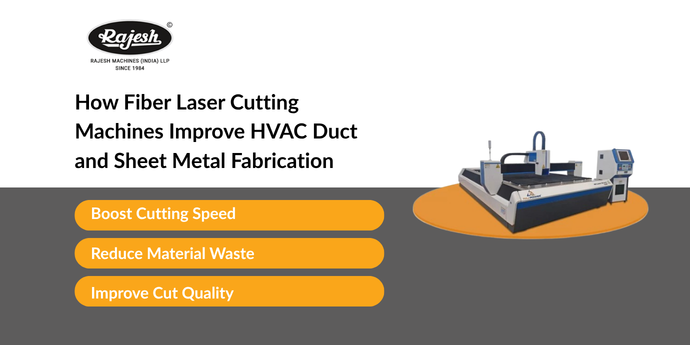
For decades, plasma tables were the default answer for duct fabrication. Rugged, affordable, and “good enough” — until good enough stopped being enough. Plasma leaves dross that has to be scraped off by hand. It burns away the zinc coating on galvanized steel around every cut, leaving bare metal that rusts over time. And on the thin-gauge material most ductwork is made from, it’s simply not fast enough to keep up with modern production quotas.
Fiber laser cutting didn’t just speed up the old process — it changed what’s actually possible in a fabrication shop. This piece looks at why, specifically for HVAC duct work and for sheet metal fabrication more broadly, and where the technology actually earns its cost.
What Makes Fiber Laser Different
A fiber laser cutting machine generates its beam through a solid-state fiber optic source rather than a gas medium (as CO2 lasers do) or an electric arc (as plasma does). That beam is focused to a very small spot, which is the reason for almost every advantage that follows: less heat spreads into the surrounding material, the cut is narrower, and the machine can move faster without sacrificing accuracy. A CNC control system drives the cutting head along a programmed path, so the process is repeatable in a way manual and semi-manual cutting never was.
Why This Matters Specifically for HVAC Duct Fabrication
Roughly 90% of ductwork is made from galvanized steel — usually in the 0.5mm to 1.2mm range — coated in zinc specifically to resist corrosion. That coating is exactly what plasma cutting damages.
Plasma’s problem: the arc melts a wide path and generates enough heat to vaporize the zinc coating for millimeters around the cut edge. That leaves bare steel exposed, which rusts over time, plus dross clinging to the edge that someone has to scrape off before the part can move to folding or assembly. None of that is value-added labor — it’s cleanup.
What fiber laser does instead: the heat input is tightly localized, so the zinc coating barely gets disturbed. Cutting with nitrogen or compressed air as the assist gas can even blow a microscopic layer of molten zinc back over the cut edge — a self-healing corrosion barrier that plasma simply can’t produce. Parts come off the table clean and go straight to the next process step.
The speed difference is not subtle. On 0.8mm galvanized steel, plasma typically runs 3–5 meters per minute. A standard fiber laser in the 1.5–3kW range can cut the same material at 30–50 meters per minute. When you’re producing thousands of flange connectors or hundreds of meters of duct blank rather than one intricate part, that gap compounds fast.
Precision matters for fit, not just appearance. Fiber laser cutting typically holds accuracy around ±0.1mm, against roughly ±0.3–0.5mm for plasma, with a much smaller heat-affected zone. For ductwork specifically, where components need to seat correctly and joints need to stay airtight, that tolerance difference is the line between a duct system that installs cleanly and one that needs field rework.
The Broader Benefits for Sheet Metal Fabrication
The advantages above aren’t HVAC-exclusive — they apply anywhere sheet metal gets cut to shape.
- Material savings. CNC nesting software arranges parts on the sheet to minimize scrap, and the narrow kerf width of a fiber laser cut wastes less material per part than wider mechanical or plasma cuts.
- Consistency at volume. Once cutting parameters are set for a material and thickness, every part comes out identical — there’s no operator-to-operator variation the way there can be with manual cutting or shearing.
- Versatility across materials. Galvanized steel, stainless steel, aluminum, and even copper and brass can all be cut on the same machine with parameter changes rather than tooling changes, which matters for shops that don’t run a single material all day.
- Lower running cost than older laser technology. Fiber lasers convert electricity to cutting power far more efficiently than CO2 laser systems — typically cited around 70% lower electricity consumption for equivalent work — and have fewer consumable parts and lower maintenance requirements than gas-laser or plasma systems.
- Less secondary processing. Clean, burr-free edges reduce or eliminate the grinding and deburring step that both plasma and mechanical cutting usually require, which is labor cost that disappears entirely rather than just getting faster.
Fiber Laser vs. Plasma: The Honest Tradeoffs
Fiber laser isn’t the right call for every job, and a fair comparison should say so.
| Factor | Fiber Laser | Plasma |
|---|---|---|
| Accuracy | ~±0.1mm | ~±0.3–0.5mm |
| Cut edge | Clean, minimal dross | Dross present, often needs cleanup |
| Speed on thin gauge (under ~3mm) | Significantly faster | Slower |
| Speed/cost on very thick plate | Higher-power laser needed, cost rises | Often more economical |
| Zinc coating preservation | Minimal disturbance | Burns off around the cut |
| Upfront investment | Higher | Lower |
| Operating cost per part | Lower at volume | Higher — consumables, cleanup labor |
The practical takeaway: plasma still has a place on heavy-gauge material where tolerance requirements are loose and upfront cost is the deciding factor. For thin-gauge HVAC ductwork specifically — and for any sheet metal work where edge quality, tolerance, and throughput matter — fiber laser has become the clear standard, which is why the industry has moved as decisively as it has.
What to Look for in a Fiber Laser Machine for This Kind of Work
Not all fiber laser machines are built the same, and for HVAC-grade thin-gauge work in particular, a few specs matter more than raw laser power:
- Positioning accuracy — this determines whether your tight-tolerance duct fittings actually seat correctly
- Traverse speed — how fast the cutting head moves, which is the real driver of throughput on thin material where cutting itself is fast but travel between cuts adds up
- Cutting head and optics quality — affects edge quality and how consistent your cuts stay as the machine runs for hours
- Power range flexibility — enough headroom to handle occasional thicker stainless or structural work without needing a second machine
Rajesh Machines’ CNC Fiber Laser Genius Series is built around exactly this profile: positioning accuracy of ±0.03–0.05mm, traverse speeds up to 150 m/min, a Swiss RayTools cutting head, Japanese Mitsubishi servo motors, and Taiwanese HIWIN linear guides for consistency over long production runs. Laser source power scales from 700W up to 10,000W across the range, so the same platform covers thin-gauge galvanized duct work and heavier stainless or structural cutting without switching machines — and it runs at roughly 70% lower electricity consumption than an equivalent CO2 laser system. For shops working with a narrower material and thickness range, the CNC Fiber Laser Smart Series offers the same build quality in a more focused configuration.
Conclusion
The shift from plasma to fiber laser in HVAC and sheet metal fabrication isn’t a marginal upgrade — it changes the economics of the whole process. Cleaner edges mean less rework. Preserved zinc coating means fewer corrosion callbacks. Higher throughput on thin material means the same floor space produces more parts per shift. For shops still running plasma on thin-gauge galvanized work, the gap between “good enough” and what’s now standard has gotten hard to ignore.
FAQ
Is fiber laser cutting worth it for a smaller HVAC fabrication shop?
It depends on volume and material mix. Shops running consistent thin-gauge galvanized production see the fastest payback through reduced cleanup labor and material waste; very low-volume or heavy-plate-only shops may find plasma’s lower upfront cost still makes sense.
Does fiber laser cutting really preserve the zinc coating on galvanized steel?
Yes, largely — the tightly localized heat input disturbs far less of the coating than plasma’s wider arc, and cutting with nitrogen or compressed air can leave a thin protective zinc layer back over the cut edge.
What laser power do I need for HVAC duct work?
Most galvanized duct material (0.5–1.2mm) cuts well on the lower end of the power range — 700W to 1500W is often sufficient. Higher power becomes relevant if the shop also handles thicker stainless steel or structural components.
How does fiber laser cutting affect production cost per part?
Lower material waste from precise nesting, minimal secondary finishing, and lower electricity consumption per cut all reduce cost per part at volume, even though the machine’s upfront cost is higher than plasma.
Can one fiber laser machine handle both HVAC ductwork and general sheet metal fabrication?
Yes — a machine with a wide power range and accurate positioning can move between thin-gauge galvanized duct work and heavier stainless or aluminum fabrication without needing separate equipment.