
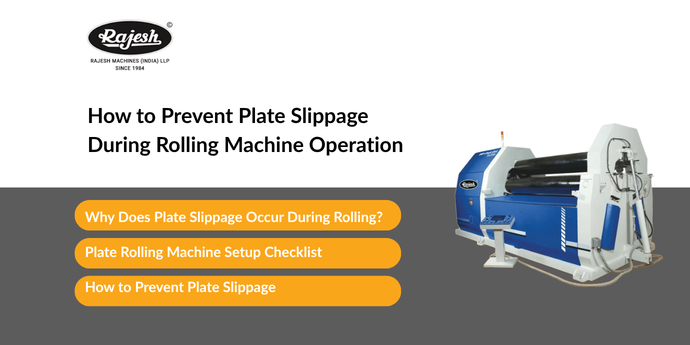
Plate slippage happens when the plate doesn’t move through the rollers at a consistent, controlled rate — it slides, drifts or loses grip against one or more rollers instead of being drawn through evenly. On metal plate rolling machines, even a small amount of slippage during a pass can throw off the curvature being formed, since the plate’s position relative to the rollers is what determines the bend radius at every point along its length.
The effects usually show up as inconsistent roundness, a diameter that varies along the plate’s length, or a shell that doesn’t close evenly at the seam. Because rolling is a progressive process — each pass builds on the position established in the last — slippage early in a job tends to compound rather than correct itself, which is why it’s worth treating as a setup and technique issue rather than something to work around after the fact.
Why Does Plate Slippage Occur During Rolling?
Slippage is rarely down to one single cause. In practice, it tends to come from some combination of the following:
- Incorrect plate positioning — the plate isn’t square to the rollers or isn’t centred correctly before the pass starts
- Improper roller adjustment — the gap or pressure between rollers doesn’t suit the plate’s thickness or material
- Roller misalignment — the rollers themselves aren’t parallel or level with each other, so contact pressure varies across the plate width
- Incorrect pressure/contact — too little pressure and the rollers can’t grip the plate; too much and the plate can distort instead of feeding smoothly
- Oil, dirt, scale, or contamination on the plate or rollers — reduces friction at the exact point where grip matters most
- Plate thickness outside the machine’s suitable range — material that’s too thin or too thick for the machine’s rated capacity is harder to feed consistently
- Incorrect feeding or operating technique — uneven feed speed or inconsistent operator handling during the pass
Because these causes overlap in their effects, the same symptom — the plate drifting to one side, for example — can trace back to misalignment, contamination or uneven feeding depending on the job. That’s why prevention works better as a checklist across setup and operation rather than a single fix.
How Does the Rolling Machine Working Principle Affect Plate Grip?
The rolling machine working principle is based on passing a plate between rotating rollers that apply controlled pressure to gradually form the material into the required curve. In a plate rolling machine, the position of the rollers determines how the plate is supported, gripped and progressively bent during each pass.
For a rolling machine for sheet metal, consistent contact between the plate and rollers is particularly important. If the plate enters at an incorrect angle or the roller settings don’t match the material, the contact pressure can become uneven and increase the possibility of slipping.
This is why the plate rolling machine working principle and machine setup need to be considered together. Correct roller positioning, suitable pressure and controlled feeding help maintain the grip required for consistent forming.
How to Prevent Plate Slippage During Rolling Machine Operation
Check plate and roller condition
Before starting a run, check both the plate surface and the rollers for oil, dirt, scale or debris. Contamination reduces the friction the rollers rely on to grip and feed the plate, and it’s one of the easier causes to rule out before looking at machine adjustment.
Align the plate correctly
The plate needs to be positioned square to the rollers and centred before the pass begins. A plate that enters the rollers at an angle, or off-centre, is more likely to drift sideways as rolling progresses, since the contact pressure won’t be even across its width.Lorem ipsum dolor sit amet, consectetur adipiscing elit. Ut elit tellus, luctus nec ullamcorper mattis, pulvinar dapibus leo.
Verify roller alignment
Roller alignment affects grip consistency across the full width of the plate. Rollers that aren’t parallel, or that have developed unevenness through wear, create inconsistent contact pressure — which shows up as slippage on one side even when the plate was positioned correctly to start with.
Set the rollers according to plate thickness
Roller gap and pressure need to be set for the specific plate thickness and material being rolled, not left at a general setting. This is also where roller configuration matters: on a 3 roll hydraulic plate rolling machine, the top roller position controls the bend as the plate is fed between the two lower rollers, so its adjustment directly affects grip through the pass.
A 4 Roll Hydraulic Plate Rolling Machine adds a fourth roller that supports the plate differently, which can help maintain consistent contact on certain plate thicknesses and reduce the tendency for the plate to shift during the pass.
Use proper pre-bending
Pre-bending the leading and trailing edges of the plate before the main rolling pass helps those edges follow the intended curve from the start, rather than staying flat and creating an uneven contact point that can contribute to slippage as the pass continues.
Feed the plate evenly
A consistent, controlled feed rate through the rolling machine process matters as much as the initial setup. Feeding too fast, too slow, or unevenly changes the contact dynamics between plate and roller mid-pass, which can introduce slippage even when the machine was set up correctly beforehand.
Maintain consistent operating conditions
Where possible, keep the same feed rate, pressure and technique across repeat passes and repeat jobs on similar material. Inconsistent operating conditions from one pass to the next make it harder to isolate whether a slippage issue is coming from the setup or from how the plate was fed.
Plate Rolling Machine Setup Checklist
Before starting a rolling job, it’s worth working through a short checklist rather than relying on memory or habit:
- Machine condition — confirm the machine is running normally with no unusual noise or movement
- Roller alignment — verify rollers are parallel and level with each other
- Plate positioning — confirm the plate is square and centred before starting the pass
- Roller adjustment — set roller gap and pressure to match the plate’s thickness and material
- Surface cleanliness — check both plate and rollers are free of oil, dirt and scale
- Trial rolling — run a short test pass where practical before committing to the full plate
Common Plate Rolling Problems Related to Slippage
Slippage doesn’t always announce itself directly — it often shows up as one of these related problems in the finished part:
- Uneven curvature — the bend radius varies along the plate’s length instead of staying consistent
- Plate drifting sideways — the plate shifts laterally during the pass rather than feeding straight through
- Inconsistent diameter — the rolled shell doesn’t hold a uniform diameter along its length
- Edge deformation — the leading or trailing edge distorts instead of following the intended curve
- Surface marks — visible marking on the plate where contact pressure or contamination caused localised slipping
When to Check the Rolling Machine
Correct setup and technique resolve most slippage issues, but persistent problems are sometimes a sign the machine itself needs attention rather than the process. It’s worth checking the machine when:
- Slippage continues despite correct plate positioning, roller adjustment and clean surfaces
- Roller movement feels uneven or inconsistent across a pass
- Hydraulic or mechanical performance seems inconsistent from one job to the next
- Rollers or other components show visible wear that could be affecting grip
Where plate preparation itself is contributing to the problem — an inaccurately cut edge feeding unevenly into the rollers, for example — it’s also worth checking the equipment used to prepare the plate beforehand. A shearing machine that isn’t cutting a clean, square edge can pass that inconsistency straight into the rolling operation.
Choosing the Right Rolling Machine for the Job
Slippage prevention also starts with selecting a machine that matches the material and production requirements. A hydraulic rolling machine may be suitable for applications requiring controlled roller movement and consistent forming force, while different rolling machine types can be selected according to plate thickness, working width, required diameter and production volume.
For heavier materials, the machine’s rated capacity needs to be checked against the actual plate thickness and material strength. The number and arrangement of rollers also influence how the plate is supported and formed during the rolling process.
The goal is not simply to choose a machine with the highest capacity. The machine should match the actual plate dimensions, material and forming requirements so that the rollers can maintain consistent contact throughout 4 Roll Hydraulic Plate Rolling Machine the job.
Conclusion
Plate slippage during rolling is rarely down to a single cause, and it’s rarely a job for one adjustment alone. Correct plate alignment, verified roller alignment, roller settings matched to the plate’s thickness, and controlled, consistent feeding are the factors that work together to keep a plate rolling accurately through a pass.
Where slippage persists despite attention to all of these, it’s a reasonable signal to look at the machine itself — whether that’s a 3 roll hydraulic plate rolling machine, a 4 Roll Hydraulic Plate Rolling Machine, or a mechanical plate rolling machine — rather than continuing to adjust technique around a machine-side issue.
FAQs
1. What type of plate is suitable for rolling machines?
Plate rolling machines can process materials such as mild steel, stainless steel and other metals, provided the material thickness and strength fall within the machine’s rated capacity. The required roller setup may vary according to the material.
2. How does plate width affect rolling machine performance?
Plate width affects the load distribution across the rollers and the machine’s required working capacity. The machine should have a suitable maximum rolling width for the plate being processed to maintain stable and consistent forming.
3. What is the minimum rolling diameter of a plate rolling machine?
The minimum rolling diameter depends on the machine design, roller diameter, plate thickness, material and rolling configuration. Manufacturers should check the machine’s specifications for the minimum diameter achievable with their particular plate.
4. Can worn rollers cause problems during plate rolling?
Yes. Excessive roller wear can affect contact with the plate and contribute to inconsistent forming or uneven results. Regular inspection can help identify worn surfaces or other mechanical issues before they affect production.
5. Why is a test piece useful before rolling a full plate?
A test piece allows the operator to verify the roller settings, forming result and material response before processing the complete plate. This can help identify incorrect settings without risking the full workpiece.
6. What maintenance helps keep a plate rolling machine working consistently?
Routine maintenance can include inspecting rollers, checking hydraulic or mechanical components, lubricating parts according to the manufacturer’s instructions and keeping the machine clean. Regular inspection also helps identify wear before it affects rolling accuracy.