
Introduction
Selecting the right power press machine shapes manufacturing success. And the C type vs H type power press debate effects on production efficiency, workspace utilization, and long-term operational costs. That’s why in this guide we walk you through the important differences between C type and H type power machine configurations which helps make an informed decision.
Understanding Power Press Machine Basics
Power presses transform metal sheets into desired shapes through force application. C-type and H-type machines operate across various industries like from automotive component manufacturing to electronics production. The frame design determines how the machine distributes force, handles workpieces, and fits into your production environment.
C-type and H-type machines both serve metalworking operations, yet the distinct structural differences offer distinct advantages for certain tasks. Recognizing the differences between C type vs H type power presses helps you match equipment capabilities to production requirements, workspace limitations and the nature of metalworking tasks at hand.
What is a C-Type Power Press Machine?
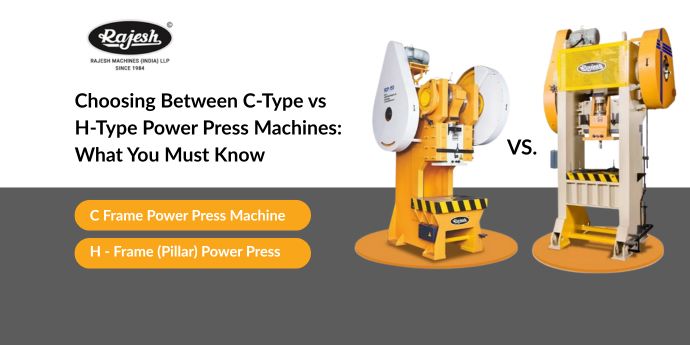
C-Frame power presses boast an open front design resembling the letter C when seen from the side, creating an “L” shape when seen from above. This gap-frame configuration creates unobstructed access to work areas on one side only of its structure.
Key Features of C Type Power Press
The open-front architecture allows operators to load and unload materials from three sides. This accessibility speeds up operations and accommodates wider workpieces. The compact footprint makes C-type machines ideal for facilities with limited floor space.
C-type power presses typically handle lighter to medium-duty applications. The single-point connection creates some frame deflection under heavy loads, which limits their capacity compared to enclosed-frame designs. Most C-type machines operate within 5 to 200-ton capacity ranges.
Common Applications
C-type machines excel at:
- Blanking and piercing operations
- Shallow drawing processes
- Stamping small to medium components
- Bending and forming sheet metal
- Prototype development and short production runs
The easy access design suits operations requiring frequent die changes or manual material handling. Industries manufacturing electrical components, kitchen utensils, and automotive parts frequently deploy C-type presses.
What is an H-Type Power Press Machine?
H-frame(pillar) power press’s feature is a closed-frame structure which forms in ‘H’ shape. This four sturdy columns connect the crown and bed and create a rigid, fully enclosed frame that distributes force evenly.
Key Features of H Type Power Press
This four-pillar construction of the H Type power press machine gives superior structural rigidity and stability. This machine design reduces the frame deflection issues and allows H-type machines to handle heavier loads and deliver consistent precision across the entire work surface.
H-type power presses handle higher tonnage requirements, which range from 100 tons to over 1000 tons. The balance force distributes and maintains dimensional accuracy even under maximum load conditions. These machines support larger bed sizes and die areas compared to C-type configurations.
Common Applications
H-type machines serve:
- Heavy-duty stamping operations
- Deep drawing processes
- Large component manufacturing
- High-volume production runs
- Precision metalworking requiring tight tolerances
Industries producing automotive body panels, large appliance components, and heavy machinery parts rely on H-type presses. The robust construction handles continuous operation without compromising accuracy.
C Type vs H Type Power Press: Direct Comparison
Let’s now evaluate C type vs H type power press options, considering multiple factors which later on impacts daily operations and long-term productivity. Here’s a detailed comparison:
Frame Structure and Stability
C-type machines offer open accessibility but experience some deflection under load. The single-sided frame attachment limits rigidity. H-type machines provide maximum stability through four-point support, eliminating deflection concerns and maintaining precision under heavy loads.
Workspace Accessibility
The C-frame design wins for accessibility. Operators access the work area from three sides, simplifying material handling and die changes. H-type machines restrict access to front and rear approaches due to the pillar structure, which may slow some operations.
Tonnage Capacity
H-type presses dominate heavy-duty applications. The closed-frame construction handles higher tonnages without structural compromise. C-type machines suit lighter operations where extreme force isn’t required. Your tonnage requirements often determine which frame type fits your needs in the C type vs H type power press decision.
Precision & Accuracy
H-type machines provide tighter tolerances over larger work areas due to their rigid frame’s ability to prevent deflection which affects dimensional accuracy. C-type machines generally offer sufficient precision but may exhibit slight variations under maximum load conditions.
Floor Space Requirements
C-type presses require less floor space due to their compact design. The open-front configuration also allows closer positioning to walls or other equipment. H-type machines need more space to accommodate their pillar structure but offer larger work areas within that footprint.
Cost Considerations
C-type machines typically cost less upfront. Their simpler construction reduces manufacturing expenses. H-type presses represent a larger investment but deliver superior durability and capability. Calculate your total cost of ownership, including maintenance and productivity factors.
How to Choose the Right Press Machine for Your Business: C Type vs H Type Power Press
Assess Your Production Requirements in the C Type vs H Type Power Press Selection
Start by analyzing your typical workpieces. Measure their dimensions, material thickness, and required forming force. Operations involving parts wider than 600mm or requiring forces above 150 tons generally favor H-type machines.
Review your production volume. High-volume operations benefit from the durability and consistency of H-type presses. Lower-volume or diverse production suits the flexibility of C-type machines. The C type vs H type power press choice directly correlates with your specific production demands.
Evaluate Your Workspace
Measure your available floor space and ceiling height. Account for operator movement areas and material storage. C-type machines fit tighter spaces, while H-type machines need room for their pillar structure.
Consider material flow through your facility. The three-sided access of C-type machines simplifies integration into some production layouts. H-type machines work well in linear production setups.
Consider Future Scalability
Think beyond current needs. Will your production expand? Will you manufacture larger or heavier components? H-type machines offer more growth capacity, while C-type machines suit businesses with stable, well-defined requirements.
Investment in an H-type press prevents future equipment upgrades as your business grows. However, a C-type machine provides faster return on investment for operations that won’t exceed its capabilities.
Maintenance and Operational Considerations
C-Type Machine Maintenance
The simpler construction of C-type presses generally requires less maintenance. Fewer structural components mean fewer potential failure points. Regular lubrication, ram alignment checks, and clutch inspections keep C-type machines running smoothly.
The open design simplifies maintenance access. Technicians reach critical components without extensive disassembly. This accessibility reduces downtime during routine maintenance.
H-Type Machine Maintenance
H-type machines require more comprehensive maintenance due to their complex structure. All four pillars need regular inspection for wear and alignment. The additional guide systems demand proper lubrication and adjustment.
However, the robust construction extends service life. Well-maintained H-type presses operate reliably for decades. The initial maintenance investment pays off through reduced breakdown frequency and consistent performance.
Shop C-Type and H-Type Power Presses From Rajesh Machine Middle East
When you’re ready to move forward with your C type vs H type power press decision, Rajesh Machine Middle East offers comprehensive solutions for both machine configurations. Our equipment lineup serves diverse manufacturing requirements across the Middle East region.
Our technical team offers expert consultation to assist in selecting the ideal press configuration for your unique applications. They evaluate production needs, space constraints and budgetary considerations in order to identify a suitable solution.
Our machines feature quality construction, reliable components, and proven performance in industrial environments. We support your operations with installation guidance, operator training and responsive after-sales service – whether you require a compact C-frame solution or heavy-duty H-frame system, we deliver equipment that enhances manufacturing capabilities.
Visit our website to see both machine types in power presses. Our demonstration units allow hands-on evaluation before you commit to a purchase decision.
Conclusion
Your decision between C type vs H type power press has an immediate effect on production efficiency and product quality. C-type machines provide easy accessibility, compact size and cost effectiveness for lighter applications while H-type presses may offer more benefits such as larger capacities or additional features that meet certain application needs. H-type machines provide unrivaled rigidity, higher capacity and consistent precision for demanding operations. Gaining insight into C-type power press machine design, applications and benefits allows you to better match equipment to your manufacturing requirements. Assess your current needs, anticipate growth plans, and consult with knowledgeable suppliers in order to select a power press configuration that maximizes operational success. Selecting an optimal C type vs H type power press now lays the groundwork for years of profitable manufacturing operations ahead.